Showing posts with label Robert Mapplethorpe. Show all posts

24/07/25

Robert Mapplethorpe. Le forme del classivo / The Forms of Classicism @ Le Stanze della Fotografia, Venice

Robert Mapplethorpe 
Le forme del classivo / The Forms of Classicism
Le Stanze della Fotografia, Venezia
The Rooms of Photography, Venice
Through 6 January 2026

Robert Mapplethorpe
Robert Mapplethorpe
Self Portrait, 1975 
Photo © Robert Mapplethorpe Foundation. Used by permission

Robert Mapplethorpe
Robert Mapplethorpe
The Sluggard, 1978
Photo © Robert Mapplethorpe Foundation. Used by permission

Robert Mapplethorpe
Robert Mapplethorpe
Derrick Cross, 1983
Photo © Robert Mapplethorpe Foundation. Used by permission

Robert Mapplethorpe
Robert Mapplethorpe
Dennis Speight, 1983
Photo © Robert Mapplethorpe Foundation. Used by permission

Le Stanze della Fotografia / The Rooms of Photography in Venice hosts a major exhibition dedicated to one of the most influential – and still, in many ways, provocative – figures in international photography: ROBERT MAPPLETHORPE (New York, 1946 – Boston, 1989). Curated by Denis Curti, Artistic Director of Le Stanze della Fotografia, Robert Mapplethorpe. Le forme del classivo is organised and promoted by Marsilio Arte and the Fondazione Giorgio Cini, in collaboration with the Robert Mapplethorpe Foundation.

This retrospective marks the first chapter in a broader trilogy dedicated to the study and exploration of Mapplethorpe’s work. Two further exhibitions will follow in 2026. Robert Mapplethorpe. Le forme del desiderio [The forms of desire], to be held at Palazzo Reale in Milan, will present a comprehensive retrospective of the artist’s most iconic, powerful, and daring images, focusing on the most intense aspects of his practice. Robert Mapplethorpe. Le forme della bellezza [The forms of beauty] will be shown at the Museo dell’Ara Pacis in Rome and will centre on Mapplethorpe’s reflections on beauty as classical ideal, featuring direct comparisons and a special section devoted to a number of significant photographs taken in Italy, now exhibited for the first time.

To accompany the trilogy, a single major catalogue will be published by Marsilio Arte, gathering all three exhibitions into one comprehensive volume. Featuring 257 works, it will offer a sweeping look at Mapplethorpe’s entire output and the evolution of his visual language.
«The Robert Mapplethorpe Foundation is delighted to collaborate with Marsilio Arte, Denis Curti, and his colleagues on these upcoming exhibitions devoted to Mapplethorpe, which will be beautifully presented in three outstanding venues and institutions. Denis Curti’s thoughtful curatorial approach will offer visitors a unique experience, tailoring each show to its location and highlighting different facets of Mapplethorpe’s art. While the exhibitions will share certain themes, each will adopt a distinct perspective on his work. Venice has not hosted a major Mapplethorpe retrospective since 1992, when Germano Celant’s iconic international show was presented at Palazzo Fortuny. We eagerly anticipate Mapplethorpe’s return to Venice after 33 years, as well as the exhibitions planned for Rome and Milan», said Michael Ward Stout, President of the Robert Mapplethorpe Foundation.
Robert Mapplethorpe
Patti Smith, 1986
Photo © Robert Mapplethorpe Foundation. Used by permission

Robert Mapplethorpe
Isabella Rossellini, 1988
Photo © Robert Mapplethorpe Foundation. Used by permission

Robert Mapplethorpe
“Flowers” Purple Callas, 1987
Photo © Robert Mapplethorpe Foundation. Used by permission

Featuring over 200 photographs, some of which are on view in Italy for the first time, Robert Mapplethorpe. The Forms of Classicism at Le Stanze della Fotografia pays tribute to the great American artist and picks up the thread laid out by curator Germano Celant in his 2005 exhibition Between Ancient and Modern. An Anthology (Turin), placing Mapplethorpe’s work back into the wider context of mid-20th century American art and culture. It is this classical dimension of Mapplethorpe’s photography – particularly emphasised in Venice through direct comparisons with images of ancient statuary – that renders his portraits so striking. These bodies, captured in their sculptural beauty and form, appear timeless: age-old yet contemporary expressions of desire, shaped by the geometry of light and transfigured into eternal, almost divine icons that remain deeply, unmistakably human.

The exhibition draws attention to Mapplethorpe’s pursuit of a perfect curvature, a sensual, almost sacred roundness, evident in the depictions of both male and female bodies, as well as in his magnificent photographs of flowers. These are laid bare in all their delicacy, forming poetic, ambiguous compositions. As curator Denis Curti notes, «Mapplethorpe uses photography to reinterpret and renew classical aesthetics, heightening the dialogue between the living body and ideal sculpture. The comparison reveals his ability to transpose the grace and perfection of classical form into contemporary photography, through meticulous attention to detail and light. Statues, governed by an incomplete sexuality, remind us of the importance of flesh in the language of seduction. Mapplethorpe dissolves their marble limbs, allowing a sensual beauty to emerge from beneath layers of rigidity, breathing new life into them».

The exhibition opens with Mapplethorpe’s earliest collages and ready-mades from the late 1960s, many of which have never been shown before. Created using original drawings, cuttings from homoerotic magazines and objets trouvés, these early pieces reflect his search for identity and his fascination with experimentation from the outset of his career, layering disparate elements into bold visual statements.

Robert Mapplethorpe
Robert Mapplethorpe. Le forme del classico
Le Stanze della Fotografia, Venice
Exhibition View. Photograph by Matteo de Fina

Robert Mapplethorpe
Robert Mapplethorpe. Le forme del classico
Le Stanze della Fotografia, Venice
Exhibition View. Photograph by Matteo de Fina

Robert Mapplethorpe
Robert Mapplethorpe. Le forme del classico
Le Stanze della Fotografia, Venice
Exhibition View. Photograph by Matteo de Fina

These are followed by portraits of his companion, friend, and muse Patti Smith, captured in intimate, iconic poses that convey both her androgyny and vulnerability; and by images of bodybuilder Lisa Lyon, which explore strength, endurance and femininity while transcending conventional notions of gender. Mapplethorpe depicts her sculpted body with classical precision, celebrating power and beauty through an aesthetic grounded in antiquity.

Unsettling self-portraits reveal his ongoing exploration of identity as something fluid and mutable. Through carefully constructed poses and provocative symbolism, Mapplethorpe presents himself both as artist and subject, examining the boundaries between the private self and public persona.

Robert Mapplethorpe
Robert Mapplethorpe. Le forme del classico
Le Stanze della Fotografia, Venice
Exhibition View. Photograph by Matteo de Fina

Robert Mapplethorpe
Robert Mapplethorpe. Le forme del classico
Le Stanze della Fotografia, Venice
Exhibition View. Photograph by Matteo de Fina

Robert Mapplethorpe
Robert Mapplethorpe. Le forme del classico
Le Stanze della Fotografia, Venice
Exhibition View. Photograph by Matteo de Fina

Throughout the exhibition, male nudes take centre stage as odes to classical perfection, emphasising strength, sensuality and symmetry through refined lighting and composition. These works navigate desire and eroticism while openly challenging traditional social norms. Similarly, the female nudes on display in Venice reveal Mapplethorpe’s elegant, minimalist approach: a play of curves, folds and lines that evokes what art historian Arthur C. Danto described as «self-aware women with an almost regal power».

Also on view are portraits of figures such as Truman Capote, Glenn Close, Richard Gere, Keith Haring, David Hockney, Annie Leibovitz, Yoko Ono, Robert Rauschenberg, Isabella Rossellini, Susan Sarandon, Susan Sontag, Andy Warhol and many others. For Robert Mapplethorpe, portraiture was never simply an intimate encounter between two individuals, but rather a kind of visual altar, where the subject’s physical presence becomes transfigured, enmeshed in a subtle game of desire and possession.

Robert Mapplethorpe
Robert Mapplethorpe. Le forme del classico
Le Stanze della Fotografia, Venice
Exhibition View. Photograph by Matteo de Fina

Among the most iconic works in the exhibition are his photos of flowers – calla lilies, orchids, and tulips – captured at the precise moment they seem to become taut with energy, transformed into pulsing muscle. These works strike a delicate balance between stately reverence, achieved through subtle monochrome tones, and the vibrant dynamism of colour. Throughout, ancient statuary provides a powerful point of comparison: defined by an unresolved sexuality, these classical forms underscore the centrality of flesh in Mapplethorpe’s seductive visual language.

Thanks to the Mapplethorpe Foundation, exceptional vintage ephemera are on display. The archival items include two original Patti Smith audio cassettes, a 45 rpm record, gallery and museum exhibition invitations, posters, a limited edition, signed, and leather-bound copy of Rimbaud's A Season in Hell, illustrated with Mapplethorpe gravures, magazines, handwritten letters from Mapplethorpe to his mentor and lover Sam Wagstaff, and the memorial card from Wagstaff's funeral.

Also on view in the exhibition are two short films directed by Robert Mapplethorpe: Still Moving: Patti Smith from 1978 and Lady with Lisa Lyon from 1984.

LE STRANZE DELLA FOTOGRAFIA
Venice, Island of San Giorgio Maggiore

Robert Mapplethorpe. Le forme del classico, 10 April 2025 – 6 January 2026 
Le Stanze della Fotografia, Venice, Island of San Giorgio Maggiore 

17/11/23

Robert Mapplethorpe @ Alison Jacques, London - "Subject Object Image" Exhibition

Robert Mapplethorpe
Subject Object Image
Alison Jacques, London
30 November 2023 – 20 January 2024

Robert Mapplethorpe
Robert Mapplethorpe
 
Arnold Schwarzenegger, 1976
© Robert Mapplethorpe Foundation. Used by permission

Robert Mapplethorpe
Robert Mapplethorpe 
Arnold Schwarzenegger, 1976
© Robert Mapplethorpe Foundation. Used by permission
“If you say too much, you lose some of the mystery that ends up being there. Somehow I am able to pick up the magic of the moment and work with it. That’s my rush in doing photography; you can get to a place where you can do it with a flower, with a cock, with a portrait… You’ve tapped into a space that is magic”.

Robert Mapplethorpe in Arena, 1988, BBC documentary directed by Nigel Finch
Marking 24 years of collaboration between Alison Jacques and The Robert Mapplethorpe Foundation, the gallery presents a solo exhibition of works by iconic American artist Robert Mapplethorpe (b.1946 – d.1989). Widely acknowledged as one of the most groundbreaking photographers of the 20th century, Robert Mapplethorpe’s unapologetic and provocative exploration of objectivity in his subjects challenged societal norms and pushed the boundaries of the times. While some of his photographs remain controversial, Robert Mapplethorpe’s legacy is unquestionable, evidenced by work acquired and exhibited by major museums worldwide.

Robert Mapplethorpe lived a life of contradictions, existing in two different worlds, from the uptown glamour, fame and intelligentsia of Manhattan, to the hedonism of Studio 54, drugs and open sexual activity, and the underground BDSM subculture. His vision was a relentless pursuit of aesthetic equilibrium through meticulous attention to detail, lighting, and composition. This brought a sense of formality and precision to his subjects, often portraying them as inanimate objects. Robert Mapplethorpe stated in 1983, “I’m trying to make sculpture without having to sculpt. I’m trying to get the head in just the right spot where everything looks perfect. I’m looking for perfection in form… It’s no different from one subject to the next…”

‘SUBECT OBJECT IMAGE’, spans 13 years of Robert Mapplethorpe’s life and covers the breadth of his subject matter. The show begins in 1976 when Robert Mapplethorpe had already evolved from Polaroids and begun using a Hasselblad 500 camera. The exhibition concludes with images made in the final year of the artist’s life before his tragic death in 1989 at the age of only 42. Mapplethorpe’s own words in 1983 communicate the premise of this exhibition: “It’s a different subject, same treatment, same vision, which is what it’s all about - my eyes as opposed to someone else’s…” Regardless of who or what he chose to photograph, Mapplethorpe’s aim was to objectify his subject. In 1988 his close friend, the artist, Lynn Davis, summed this up: “He looked at it all in the face whatever it was…”

Many of the images included in the exhibition have not been widely exhibited before. These include still lifes created using everyday objects – Italian glass, antique silver and classical statuary – some of which Mapplethorpe collected together with his long-term partner, Sam Wagstaff. Mapplethorpe’s focus on the nude is evident throughout the exhibition, from the recurrent male muses – Ajitto, Derrick Cross and Ken Moody – whose portraits have become synonymous with Mapplethorpe’s photography, to female models including bodybuilder Lisa Lyon. They demand that the viewer reconsider perceptions of the human body and its beauty. Rare Dye-transfer colour photographs portraying flowers, including orchids and roses, as erotically beautiful, punctuate the otherwise monochromatic works grouped together in the exhibition.

A second space encapsulates a classic portrait gallery featuring artists and creatives from New York in the 1970s and 80s. Willem de Kooning, Richard Gere, Yoko Ono, Paloma Picasso and Andy Warhol hang alongside an oversized portrait of British musician Steve Strange, who stares out at the viewer. A grouping of four portraits of Arnold Schwarzenegger from a single shoot are shown alongside the artist’s intimate circle including his brother Edward, his lovers Milton Moore and Jack Walls, and poet and musician Patti Smith. Many of these portrait sessions were held in his fifth floor studio at 24 Bond Street, Lower Manhattan.

Accompanying some of the portraits in the show, are recollections of the subjects’ experience of being photographed by Robert Mapplethorpe:
“I had been working with Robert for just about one year when he asked if he could take my portrait. At the time, I was deep into the New York rockabilly revival scene so I was always fairly precise with my hairstyle which Robert rather enjoyed.

Having already been by his side a countless number of times when taking portraits, I was well aware of what to expect and what would be required of me that day. We set the studio lighting evenly (two strobe heads with umbrellas) and we decided a white background would be best to contrast the dark tones of my hair and coat.

Like so many others before me, I got lost in my head listening to his instructions to turn, lift and look. It was this genius of his attention to detail that has made so many of Robert’s portraits so revealing.

Now, forty years later… I see a rather cocky, self-assured young man in this picture. Isn’t it wonderful how innocent some of us can be in our youth?”

Edward Mapplethorpe (2023)
His portraits are a testament to the internal and external beauty of people – of friends, celebrities and those who pushed against the fixed conventions of their time. As Robert Mapplethorpe stated in the 1988 BBC “Arena” documentary, on one of the few occasions he spoke on film: “I captured New York of its time”.

Robert Mapplethorpe would at times incorporate mirrors into his work. One of his earliest sculptures, Mirror (1971), allows the viewer to see their own reflection through a wire mesh, inviting them to imagine how they might have been captured by the artist’s camera at an imaginary photo shoot. A self-portrait hangs nearby, one of the only portraits in the exhibition not to reveal the sitter’s face, showing instead, the back of the artist’s head and leather jacket.

Robert Mapplethorpe’s still lifes, flowers and portraits fall within the same tradition of the memento mori – they are reflections on the inevitability of death, but also celebrations of the potential abundance of life that precedes it. The fact that Robert Mapplethorpe’s legacy is so renowned is testament to his enduring belief that beauty and “perfection in form” can be found in any walk of life.

ROBERT MAPPLETHORPE was born in Floral Park, Queens, New York (1946). A strictly Catholic and suburban upbringing led him to leave home at age 16 and enrol at the Pratt Institute in Brooklyn, to study Advertising Design before transferring to Graphic Arts. His first solo exhibition, ‘Polaroids’ at Light Gallery took place in 1973, and subsequent shows followed at Holly Solomon Gallery and The Kitchen. In 1977, Robert Mapplethorpe participated in ‘Documenta 6’ in Kassel, Germany, followed later in Europe with a solo exhibition at the Institute of Contemporary Arts, London (1983). London’s support for Robert Mapplethorpe continued with a survey of his portraits at the National Portrait Gallery (1988). The year before Mapplethorpe’s death from AIDS-related complications, The Whitney Museum of American Art mounted Mapplethorpe’s first major American museum retrospective (1988). It was followed by the exhibition ‘The Perfect Moment’ in December 1989, at the Institute of Contemporary Art in Philadelphia. This exhibition toured in the United States and created one of the fiercest episodes of America’s “Culture Wars” – joining a recurring debate about federally-funded cultural projects and support of homoerotic, sexually explicit or perceived sacrilegious art.

Robert Mapplethorpe established The Robert Mapplethorpe Foundation on May 27, 1988, the year before his death, to protect his work, to advance his creative vision and to promote the causes he cared about. Serving as the first president of its board of trustees, he established two mandates: to promote photography as an art form in order to achieve its recognition and respect at the same level as painting and sculpture; and to financially support HIV/AIDS medical research. 34 years later, in keeping with Mapplethorpe’s wishes, The Robert Mapplethorpe Foundation, stewarded by Michael Ward Stout, continues to support photography programming at major museums as well as small institutions, for exhibitions, acquisitions, and publications. The Foundation has donated millions of dollars to fund medical research to help eradicate HIV and AIDS which killed over 100,000 people during Mapplethorpe’s lifetime.

ALISON JACQUES GALLERY
22 Cork Street, London W1S 3NG

14/10/16

Robert Mapplethorpe: Icon, McCabe Fine Art, Stockholm

Robert Mapplethorpe: Icon 
McCabe Fine Art, Stockholm 
October 14 - December 14, 2016 

Robert Mapplethorpe is a cultural icon. He began his career taking Polaroids in the 1970s and went on to become one of the twentieth century's most important artists. Well known for his provocative nudes, Mapplethorpe also took sensual photographs of artists, celebrities, friends, lovers, and flowers. The artist’s first commercial exhibition in Sweden features a diverse selection of portraits, landscapes, and still lifes from the 1970s and 1980s. All of the works on view, have been provided by the Mapplethorpe Foundation.

Regardless of whether or not Mapplethorpe’s subjects themselves are icons - as many are, including Grace Jones, Iggy Pop, and Patti Smith, whose portraits are included in this exhibition - his photographs are iconic in the way that they portray people, places, and things in an idealized, spiritual, manner. Always searching for perfection in his subjects (while holding himself to equally high artistic standards), Robert Mapplethorpe strived to maximize the splendor and elegance of the human body and the natural world. Carefully controlling light and shadows, he meticulously staged his subjects to enhance sumptuous textures, ranging from smooth skin and frothy water, to hard marble and soft petals. By cropping his photographs in unexpected ways, he created dynamic compositions that highlight idealized forms.

Mapplethorpe’s passionate fascination with the human body evokes Classical sculpture. His cropped nudes, which focus in on muscular thighs and buttocks, sinewy arms, or perfect breasts, are as powerful, idealized, and fetishistic as Greek Gods and Goddesses. By shooting subjects whose bodies are already chiseled works of art, Robert Mapplethorpe celebrates the human form as the epitome of beauty, strength, and goodness. His nudes are erotic, not exploitative; romantic, not raunchy. Bringing the same precision lighting, framing, and composition to still life subjects that he did to his live models, Robert Mapplethorpe likewise improves upon perfection in the natural world. Through his lens, a single delicate Calla Lily or Orchid bud appears robust, majestic, and everlasting. Instead of capturing fleeting moments, Mapplethorpe’s photographs are imbued with a profound sense of timelessness. This is perhaps why his images - so striking, so thoughtful, so perfect, and so iconic - remain deeply etched in our collective memory, nearly thirty years after the artist’s death.

MCCABE FINE ART
Artillerigatan 40, 11445 Stockholm

22/11/15

Robert Mapplethorpe: The Perfect Medium @ LACMA, Getty Museum, Montreal Museum of Fine Arts, Art Gallery of New South Wales, Sydney...

Robert Mapplethorpe: The Perfect Medium 
LACMA - Los Angeles County Museum of Art
March 20 - July 31, 2016
J. Paul Getty Museum, Los Angeles 
March 15 - July 31, 2016 
Montreal Museum of Fine Arts
September 10, 2016 - January 15, 2017 
Art Gallery of New South Wales, Sydney 
October 28, 2017 - February 4, 2018

Robert Mapplethorpe
Robert Mapplethorpe, Lisa Lyon, 1982 
Gelatin silver print
Promised gift of The Robert Mapplethorpe Foundation to The J. Paul Getty Trust 
and the Los Angeles County Museum of Art 
© Robert Mapplethorpe Foundation

The Los Angeles County Museum of Art (LACMA) presents Robert Mapplethorpe: The Perfect Medium, a major retrospective examining the work and career of one of the most influential visual artists of the 20th century. Robert Mapplethorpe: The Perfect Medium is co-organized by LACMA and the J. Paul Getty Museum. In a historic collaboration, the two institutions will trace the artist’s working methods and materials, presenting the improvisational, experimental aspects of his practice alongside the refined perfection of his prints. The works on display provide new context for understanding the key genres that Mapplethorpe pursued: portraiture, the nude, and still life. His personal connections to sitters, his ability to manage a  successful studio, and his ambition to elevate photography to the status of contemporary art will be demonstrated through rarely seen correspondence, books, and other ephemera, including those from the artist’s archive held by the Getty Research Institute. 

Robert Mapplethorpe
Robert Mapplethorpe, Self-Portrait, 1980 
Gelatin silver print
Promised gift of The Robert Mapplethorpe Foundation to The J. Paul Getty Trust 
and the Los Angeles County Museum of Art 
© Robert Mapplethorpe Foundation

LACMA’s presentation (March 20–July 31, 2016) focuses on Mapplethorpe’s working methods, sources, and creative processes—the experimental and performative aspects of his work—while the J. Paul Getty Museum (March 15–July 31, 2016) highlights the artist’s disciplined studio practice, figure studies, and legacy. Between the two museums, more than 300 works by Mapplethorpe will be on view, making this one of the largest-ever presentations of his work. The objects on view in Robert Mapplethorpe: The Perfect Medium are drawn almost entirely from the landmark joint acquisition of art and archival materials made in 2011 by the J. Paul Getty Trust and LACMA from The Robert Mapplethorpe Foundation. 

Robert Mapplethorpe
Robert Mapplethorpe, Patti Smith, 1978 
Gelatin silver print
Promised gift of The Robert Mapplethorpe Foundation to The J. Paul Getty Trust 
and the Los Angeles County Museum of Art 
© Robert Mapplethorpe Foundation

"4 years ago LACMA and the Getty came together to jointly acquire the art and archives of Robert Mapplethorpe," said Michael Govan, LACMA CEO and Wallis Annenberg Director. "It has been an exciting collaboration ever since, as our researchers, conservators, and curators have all spent time with this trove of Mapplethorpe's art. Now, we are glad to present this large-scale joint exhibition to Los Angeles and the world."

“Through this historic collaboration, the LACMA and J. Paul Getty Museum exhibitions offer a new perspective on this influential artist,” said Britt Salvesen, curator and head of the Wallis Annenberg Photography department. “Robert Mapplethorpe: The Perfect Medium reveals the rich resources of the Mapplethorpe archive, which provides a broader context for the iconic images that brought him fame. Mapplethorpe’s refined style challenged viewers to consider his portraits, flowers, and sexually explicit images as equal expressions of a personal vision. His drive to capture the perfect moment is the core of his art.”

Following its Los Angeles debut, Robert Mapplethorpe: The Perfect Medium will travel internationally beginning with the Montreal Museum of Fine Arts in Canada (September 10, 2016–January 15, 2017), the Art Gallery of New South Wales, Sydney, Australia, (October 28, 2017–February 4, 2018), and another international venue. This will be the first major traveling retrospective in North America since the landmark exhibition The Perfect Moment, organized in 1988 by the Institute of Contemporary Art in Philadelphia.

The exhibition is accompanied by a fully illustrated book, Robert Mapplethorpe: The Photographs, co-published by LACMA and the J. Paul Getty Museum. A comprehensive guide to the artist's work and career, this publication will feature an introduction by cocurators Britt Salvesen and Paul Martineau, five scholarly essays, an illustrated chronology, and a selected exhibition history and bibliography. The J. Paul Getty Museum presentation is curated by Paul Martineau, associate curator of photographs.

Exhibition Organization
The LACMA presentation is organized in five thematic sections. The first gallery establishes Mapplethorpe in the milieu of 1970s and 1980s urban gay culture, depicting himself and his models openly declaring their sexuality through clothing, body adornment, and gesture. The second gallery highlights the work Mapplethorpe created in the late 1960s and early 1970s before he took up photography in earnest. As a student of graphic design at the Pratt Institute, he demonstrated an early facility for draftsmanship and a penchant for geometric composition. He designed jewelry and temporary assemblages using items of clothing. Inspired by Andy Warhol, Jasper Johns, and Robert Rauschenberg, he also experimented with collages and constructions, often incorporating Catholic iconography and appropriated imagery from homosexual periodicals.

Robert Mapplethorpe borrowed a Polaroid camera from a friend in 1970 and, over the course of the next year, honed his vision as a photographer. These early unique images, installed in the third gallery, reveal his observational acuity and his ability to be in the moment. Mapplethorpe was one of his own best subjects, as his many self-portraits attest, and he was open about being a participant in the scenarios he depicted. The fourth gallery focuses on Mapplethorpe’s engagement with the leather and bondage community, his appropriation of pornographic source material, and his exploration of the African American male nude. Additionally, this gallery features ephemera relating to Robert Mapplethorpe’s first breakout exhibitions in New York, including a joint exhibition at The Kitchen and Holly Solomon Gallery in 1977. The fifth gallery presents work from the mid-1980s, when Mapplethorpe was running a successful studio and producing many commissioned portraits. Among his favorite subjects were the artists, musicians, and other performers he first encountered in the downtown art scene in the ’70s. He commented that photography was “the perfect medium for the 70s and 80s, when everything was fast. If I were to make something that took two weeks to do, I’d lose my enthusiasm. It would become an act of labor and the love would be gone.” 

Robert Mapplethorpe: The Perfect Medium: Exhibition Highlights

Robert Mapplethorpe, Self-portrait (1980)
Robert Mapplethorpe’s turn to photography in the early 1970s coincided with his embrace of New York’s leather subculture, and, throughout the decade, he explored the potential of both forms of expression simultaneously. His 1980 self-portrait as a surly, smoking leatherman captures the hyper masculine posturing that was concomitant with the choice of leather as a fashion statement and as a sexual fetish. Staring defiantly into the camera, Robert Mapplethorpe declares his participation in the leather community. At the same time, the photograph expresses the playful and performative aspects of his studio practice. An element of dress-up and theater is evident in much of his portraiture. This self-portrait shows the artist posing in the role of an archetypal tough-guy—a greaser complete with popped collar, a lit cigarette dangling from his lip, and hair styled into a pompadour. 

Robert Mapplethorpe, Patti Smith (1978)
Robert Mapplethorpe was studying art at the Pratt Institute, in Brooklyn, when he met Patti Smith in spring 1967. Mapplethorpe and Smith spent the next decade in close proximity, inspiring one another's artistic aspirations. Mapplethorpe chose photography as his medium in the early 1970s, whereas Smith gravitated toward poetry and music, and the two collaborated in a number of portrait sessions. Here, Smith poses in the act of cutting her hair, a gesture of defiance. As she explained in a 1975 interview, she didn't "want to walk around New York looking like a folk-singer. I like rock 'n' roll. So I got hundreds of pictures of Keith Richards, and I hung them up and then just took scissors and chopped away until I had a real Rolling Stones haircut." Mapplethorpe captured Smith's androgynous style, composing the photograph to emphasize contrasts of black and white in Smith's features and wardrobe, in the background, and even in the cat.

Robert Mapplethorpe, Lisa Lyon (1982)
Robert Mapplethorpe met Lisa Lyon at a party in 1979, and he would go on to produce nearly 200 photographs of her over the next several years. The first woman to win the International Federation of Body Builders female competition, Lyon had an androgynous, muscular physique that appealed to Mapplethorpe’s interest in the sculptural body. “I’d never seen anybody that looked like that before,” he said. “Once she took her clothes off it was like seeing something from another planet.” The pinnacle of their collaboration came with the release of the book Lady (1983), a series of portraits of Lyon. In this portrait, Mapplethorpe captures Lyon in her work-out attire, a nod to her role as an early advocate for fitness and weight training, which came to be a defining feature of early and mid-1980s American culture. 

Complementary Exhibition
The LACMA exhibition will also be accompanied by the installation Physical: Sex and the Body in the 1980s, which will feature roughly 30 works from the museum’s permanent collection. Placing Robert Mapplethorpe’s work in dialogue with his contemporaries, the installation examines the cultural and artistic upheavals of a pivotal decade in the history of American art and society. Featured artists include Bruce Weber, Kiki Smith, Sarah Charlesworth, Laura Aguilar, and Marina Abramovic, among others. Physical: Sex and the Body is curated by Ryan Linkof, assistant curator of the Wallis Annenberg Photography department.

Los Angeles County Museum of Art (LACMA)
5905 Wilshire Boulevard, Los Angeles, CA, 90036
www.lacma.org

J. Paul Getty Museum
1200 Getty Center Dr, Los Angeles, CA 90049
www.getty.edu

16/12/13

Robert Mapplethorpe, Sean Kelly Gallery, New York

Robert Mapplethorpe
Saints and Sinners 
Sean Kelly Gallery, New York 
Through January 25, 2014

ROBERT MAPPLETHORPE, Christopher Holly, 1980 
© Robert Mapplethorpe Foundation. Used by permission.

This December marks the twenty-fifth anniversary of the landmark exhibition Robert Mapplethorpe: The Perfect Moment. On the occasion of the anniversary of that defining juncture, not just in Mapplethorpe’s career, but also in the larger dialogue regarding freedom of expression in the arts, Sean Kelly brings together twenty-seven pairings of Mapplethorpe images exploring the theme of Saints and Sinners.

While some pairings in the exhibition may have more obvious connections, others are more ambiguous in their associations. The fifty-four images that comprise Saints and Sinners, some of which have rarely been exhibited, afford the viewer an opportunity to find personally meaningful connections in the work. Mapplethorpe himself deftly subverted any moral implications by presenting his subject matter in an objective, even classical manner, putting the onus on the viewer to draw their own conclusions. 

ROBERT MAPPLETHORPE, Bruce Mailman, 1981
© Robert Mapplethorpe Foundation. Used by permission.

Mapplethorpe’s Self-Portrait (1980) in drag is paired with a portrait of the french singer and actress, Amanda Lear (1976) – two unique depictions of female sexuality. The profile of a marble sculpture of Ermes (1988) is shown next to a vanitas-like composition of a human skull (1988); the former perhaps represents an ideal of physical perfection whilst the latter reminds one of the realities of mortal existence. Bruce Mailman (1981) and Christopher Holly (1980) are, in different guises, potentially perceived as either playful or nefarious – in each case the viewer is called upon to decide the implications for themselves.

Together, the photographic pairings in Saints and Sinners offer the possibility of seemingly endless personal interpretations of the work and a fresh perspective on Mapplethorpe’s practice and his fearless contribution to contemporary photography. 

ROBERT MAPPLETHORPE was born in 1946 in New York. He earned a B.F.A. from Pratt Institute in Brooklyn, where he produced artwork in a variety of media, mainly collage. The shift to photography as Mapplethorpe’s sole means of expression happened gradually during the mid-1970s. He took his first photographs using a Polaroid camera, and later became known for his portraits of artists, architects, socialites, stars of pornographic films, members of the S&M community and an array of other characters many of whom were personal friends. During the early 1980s, his photographs shifted to emphasize classical formal beauty, concentrating on statuesque male and female nudes, flowers, still lifes and formal portraits. Mapplethorpe died from AIDS on March 9, 1989, in Boston, at age 42. Since that time, his work has been the subject of innumerable exhibitions throughout the world, including major museum traveling retrospectives.

Sean Kelly represents the Robert Mapplethorpe Estate in the Americas.

SEAN KELLY GALLERY
475 Tenth Avenue - New York, NY 10018
www.skny.com

17/03/11

Robert Mapplethorpe @ Texas Gallery, Houston - Blossoming - Curated by Klaus Kertess

Robert Mapplethorpe: Blossoming
Curated by Klaus Kertess
Texas Gallery, Houston
March 10 – April 24, 2011

Robert Mapplethorpe
ROBERT MAPPLETHORPE
Dennis Speight, 1983
 © Robert Mapplethorpe Foundation
 Used by permission

A recent book of the photographs of ROBERT MAPPLETHORPE is titled Perfection in Form. This title might also accurately describe the exhibition of Robert Mapplethorpe’s photographs, Blossoming. Curated by writer and art historian, Klaus Kertess, the selection emphasizes the perfection that was Robert Mapplethorpe’s goal for all of his work. A classicist of the medium Robert Mapplethorpe exploited the blacks, greys and whites that can only be achieved in the traditional gelatin silver photograph. He also was a classicist in matters of composition, balancing lights and darks, voids and solids, and the architectural with the natural; paying attention to the most minute alignments and symmetry of the subject matter, both in the camera and the darkroom. The exhibition covers twelve years of Robert Mapplethorpe’s mature work from 1976 -1988 and contains some of the most recognizable images from that period. Klaus Kertess’ selection emphasizes the stylistic rigor of many of Robert Mapplethorpe’s images - from centered vertical images to cruciforms to horizontal landscape layers. By his selection, Klaus Kertess makes us look at the works with a more critical and structural eye than just seeing the sensational or the popular. The title Blossoming is also a reflection on the poetic and romantic aspects of the work and is a natural reference for an artist who illustrated a book of Arthur Rimbaud’s poetry and whose formative years in New York were spent in the company of the poet and rocker, Patti Smith. In his photographs Robert Mapplethorpe always found the beauty in his subjects whether it was in portraits, sexual imagery, or the sensuousness of flowers.

ROBERT MAPPLETHORPE’s work has been seen in numerous gallery and museum exhibitions worldwide. His work has also been the subject of a number of catalogues and monographs, including most recently, Perfection In Form (2009), Mapplethorpe (2007), Mapplethorpe: Polaroids (2007) and Mapplethorpe The Complete Flowers (2006). 

Texas Gallery held numerous exhibitions of the work of Robert Mapplethorpe while he was alive, beginning with Photos and Photo-Constructions in 1979. This is the Texas Gallery’s first posthumous exhibition since the artist’s death in 1989.  The Texas Gallery is grateful to Klaus Kertess, who first exhibited Robert Mapplethorpe’s Polaroids at his Bykert Gallery in New York in 1974, for selecting such a beautiful and profound exhibition. It is also grateful for the generous cooperation of the Robert Mapplethorpe Foundation and the Sean Kelly Gallery, New York, which represented Robert Mapplethorpe in the US. The gallery presents its special thanks go Monica Eulitz and Michael Stout at the Foundation and all at the Sean Kelly Gallery.

TEXAS GALLERY
2012 Peden, Houston, TX 77019

Updated Post

03/01/10

Sterling Ruby et Robert Mapplethorpe à Bruxelles


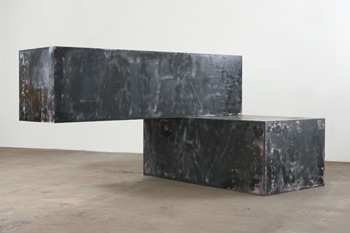
© 2009 Sterling Ruby, Cry Later, 2009.
  © 2009 Sterling Ruby, Cry Later, 2009.
  Formica, wood, spray paint, 182,8x325x243,8cm
  Courtesy Galerie Xavier Hufkens, Bruxelles.

Jusqu'au 14 janvier 2010, Xavier Hufkens consacre pour la première fois une exposition personnelle à Sterling Ruby et fait entrer ses œuvres en résonance avec le travail du photographe Robert Mapplethorpe. Parmi les clichés de Mapplethorpe sélectionnés par Sterling Ruby, celui-ci présente une série de nouveaux collages intitulée « Transcompositional » et ainsi que des sculptures issues de sa série « Acts ». 

Si Sterling Ruby est attiré par l’œuvre de Robert Mapplethorpe, c’est pour le « contraste entre le choix de sujets marginaux et la beauté formelle des photos, des fleurs et natures mortes. » Captivante, la beauté formelle de ces clichés soulève la question de l’intention l’artiste. Cherche-t-il à créer de la distance avec ses sujets ? Les fleurs, les pénis et les corps que Robert Mapplethorpe photographie sont-ils pour lui à la fois les mêmes et différents ?

Sterling Ruby prend comme point de départ des dichotomies comme beauté / marginalité, architecture / vandalisme… des contradictions qu’il remet en cause dans ses œuvres. Comme dans ses collages (série « Transcompositional ») où figurent des photographies transsexuels, témoins de la fascination de Sterling Ruby pour la transgression des identités. Ou dans ses sculptures (série « Acts ») où les parties forment un ensemble contradictoire.

Adepte du dripping pour colorer ses grandes toiles abstraites, Sterling Ruby se fait aussi remarquer pour toute la variété de pistes créatives qu’il explore. Ruby assimile les notions de couleur et d’espace pour mieux les transformer en inventant des sculptures organiques en résine et céramique, des collages et installations, des vidéos hypnotiques, des dessins au vernis à ongle, des graffitis sur aplats de couleurs…

Entre désirs individuels et contraintes sociales
Déjà appréciée par les collectionneurs, l’œuvre de Sterling Ruby intrigue par sa façon novatrice de matérialiser la tension entre désirs individuels et contraintes sociales. Prenant appui sur un solide socle théorique, Ruby emprunte les langages formels du design, du graffiti, du minimalisme ou de l’art brut, avec l’objectif avoué de se réapproprier un territoire occupé. Sterling Ruby opère ainsi une déconstruction des dispositifs de pouvoir grâce auxquels les individus intériorisent les mécanismes de contrôle social, incluant les formes institutionnelles dominantes de l'art et de l'architecture modernes. Jonglant avec des thèmes aussi variés que la mort, la violence, le sexe, le Zen, l’architecture, Ruby mêle le décoratif au tragique. Transgression sociale, comportements déviants, délire, névrose et paranoïa, manifestations corrompues du désir… sont autant de sujets qui émaillent son travail.

STERLING RUBY est né à Bitburg en Allemagne, en 1972. Il travaille et vit à Los Angeles, USA. Diplômé de l’Institut d’Art de Chicago (2001) et de l’Art Center College of Design de Pasadena, Californie (2005). On a ensuite pu voir ses œuvres présentées à la Biennale de Californie (2006), dans la collection des Rubell « Red Eye : LA Artists » exposée à Miami en 2006, ou encore à la Biennale de Moscou en 2007. Après deux expositions personnelles en 2008 – « Supermax » au Musée d’Art Contemporain de Los Angeles et « CHRON » au Drawing Center de New York, il a participé à des expositions de groupe, dont « Dirt on Delight » à l’Institut d’Art Contemporain de Philadelphie et au Walker Art Center de Minneapolis en 2009.

Du 5 février au 20 mars 2010, la Pace Wildenstein Galleryn, New-York, lui consacrera une exposition intitulée « 2TRAPS ».

Sterling Ruby & Robert Mapplethorpe
10 décembre 2009 - 14 janvier 2010
Galerie Xavier Hufkens, Bruxelles - Infos

01/10/09

Robert Mapplethorpe Exhibition at Alison Jacques Gallery, London

Robert Mapplethorpe: A Season in Hell
Alison Jacques Gallery, London
14 October - 21 November, 2009

Alison Jacques Gallery, London,  presents a new interpretation of the work of Robert Mapplethorpe (1946-1989). Bringing together a range of works in a variety of media, including rarely seen collages as well as photography, the exhibition focuses on the hitherto neglected roles of religious themes and imagery that informed much of Mapplethorpe’s practice throughout his career.  Since Mapplethorpe's tragically early death from complications arising from AIDS in 1989, the artist has been the subject of numerous exhibitions in museums worldwide and is now considered one of the most important photographers of the twentieth century. This new exhibition offers a timely reappraisal of the diversity of Mapplethorpe’s work, and the significance of the sacred and profane in his art.

Alison Jacques has represented the Estate of Robert Mapplethorpe in the UK since 1999; for this exhibition she has assembled a number of important works which reveal the significance of religion, of Catholicism and Satanism and the extremes of these opposites, in Mapplethorpe’s life and work. For the first time in a European gallery, five major early works will be exhibited, a series of collages from 1968-1969 when the artist was living with the poet and rock singer Patti Smith at the Chelsea Hotel. Drawing on the Catholic culture of his upbringing, Robert Mapplethorpe was inspired to make shrine-like works out of a broad range of materials, from men’s underwear to prayer cards.  However these works, both formally and substantially, become transformed more into objects of fetish than images of devotion, revealing the incessant influence of his religious background on Mapplethorpe’s life and art, and his irreverent and rebellious relationship to it. As Robert Mapplethorpe himself said “A church has a certain magic and mystery for a child…. It still shows in how I arrange things. It’s always little altars.”

Later in his career Robert Mapplethorpe became more renowned for his photography, yet the themes of Heaven and Hell, the sacred and profane, still filtered through into his practice and are very much in evidence throughout the corpus of his work.  The photographs in the exhibition bear witness to the recurrent impact of Catholicism on Mapplethorpe’s craft, such as the use of the Crucifix as a compositional device in the photographs, a framing motif or as an actual sculpture. Mapplethorpe’s influences were not, however, limited to Christian imagery; darker religious motifs, such as images of Pentagrams, references to witchcraft and shocking depictions of sexuality also feature in his work, and left Mapplethorpe mired in controversy in both life and death. Iconoclastic and aesthetically exhilarating, allusions to the sacred such as haloes in portraits, the use of traditional iconographic symbols such as white flowers, bread and, thorns, contrast powerfully with the devil imagery, of serpents and of smoke. Mapplethorpe himself in one of his most famous self-portraits assumed the aspect of Satan, complete with devil’s horns.

In 1986, a newly translated version of French poet Arthur Rimbaud’s 1873 extended poem ‘A Season in Hell’ was published with photographs by Robert Mapplethorpe. The book exemplified intriguing connections and parallels between the unorthodox and prematurely brief lives of Rimbaud and Mapplethorpe.  They shared an often defiant and libertine excess in their personal lives, born partly of their queer sexualities and partly of innately rebellious spirits.  This resistance to, and fascination with, the norms and strictures of bourgeois culture also led to both exploring through art the darker side of humanity’s private life, in all its emotional, physical and sexual complexity. To mark Rimbaud’s October birthday and the twentieth anniversary of Mapplethorpe’s death, Patti Smith, a passionate devotee of both artists, will perform especially dedicated music and poetry at the opening of the exhibition in London. In 2010, Patti Smith will publish her memoir about Robert Mapplethorpe, a diary of their love and friendship called ‘Just Kids’.

Robert Mapplethorpe's work features in the collections of many major museums around the world, including the Metropolitan Museum of Art, New York; the Solomon R. Guggenheim Museum, New York; The Museum of Modern Art, New York; Centre Georges Pompidou, Paris and Tate, London.

A new publication of ‘A Season in Hell’ by Morel Books will accompany Patti Smith’s performance and Robert Mapplethorpe’s exhibition at the gallery.

ALISON JACQUES GALLERY
16-18 Berners Street
London W1T 3LN

Next exhibition: André Butzer, 27 November 2009 - 9 January, 2010

09/02/09

Robert Mapplethorpe and Censorship – ICA Symposium


ICA - Philadelphia Exhibitions Initiative INSTITUTE OF CONTEMPORARY ART
PHILADELPHIA EXHIBITIONS INITIATIVE
AT THE PEW CENTER FOR ARTS & HERITAGE

IMPERFECT MOMENTS:
MAPPLETHORPE AND CENSORSHIP
TWENTY YEARS LATER


A TWO-DAY SYMPOSIUM COMMEMORATING ROBERT MAPPLETHORPE’S LANDMARK RETROSPECTIVE CO-PRESENTED BY THE INSTITUTE OF CONTEMPORARY ART AND THE PHILADELPHIA EXHIBITIONS INITIATIVE AT THE PEW CENTER FOR ARTS & HERITAGE
FEBRUARY 12–13, 2009

It has been two decades since the Institute of Contemporary Art (ICA) at the University of Pennsylvania organized Robert Mapplethorpe: The Perfect Moment. The traveling retrospective was curated by Janet Kardon, who was the ICA Director from 1979 to 1989 and who organized many pioneering exhibitions for the institution. The show fell victim to public outcry against government sponsorship of "obscene" art when Washington's Corcoran Gallery of Art canceled its stop on the tour for fear of negative repercussions, especially its possible impact on NEA appropriations. The Corcoran's decision sparked a controversial national debate: Should tax dollars support the arts? Who decides what is "obscene" or "offensive" in public exhibitions? And if art can be considered a form of free speech, is it a violation of the First Amendment to revoke federal funding on grounds of obscenity? To this day, these questions remain very much at issue.

The United States continues to have no clear or official cultural policy; the federal government does not grant fellowships to individual artists; and obscenity-based censorship persists, along with other content-based restrictions. Co-presented by the Institute of Contemporary Art and the Philadelphia Exhibitions Initiative at The Pew Center for Arts & Heritage, this two-day symposium at the University of Pennsylvania commemorating the 20th anniversary of Mapplethorpe's exhibition brings together worldrenowned artists, critics, and scholars to examine the legacy of the culture wars of the 1990s on the arts in the United States, as well as the issues that artists and art institutions face today.

© Robert Mapplethorpe Foundation Robert Mapplethorpe: The Perfect Moment opened in Philadelphia on December 9, 1988, four months before Mapplethorpe’s death at age 42, and remained on view through January 29, 1989.


Robert Mapplethorpe, Self portrait, 1988
© Robert Mapplethorpe Foundation. Used by Permission.

It was the largest Mapplethorpe exhibition organized to date—including celebrity portraits and still lifes as well as homoerotic and sadomasochistic scenes—and the first exhibition to travel extensively, scheduled to go to eight venues nationwide including the ICA. 

Among them:

Museum of Contemporary Art, Chicago (February 25-April 9, 1989);
 
Corcoran Gallery of Art, Washington, D.C. (July 1 – September 3, 1989);

Washington Project for the Arts, Washington, D.C. (July 21-August 13, 1989);
 
Wadsworth Atheneum, Hartford, Connecticut (October 21 – December 24, 1989);
 
University Art Museum, University of California, Berkeley (January 17-March 18, 1990);
 
Contemporary Arts Center, Cincinnati, Ohio (April 8 – May 21, 1990),
 
and the Institute of Contemporary Art, Boston, Massachusetts (June 14 – August 31, 1990) .

After an enthusiastic reception in Philadelphia and at the Museum of Contemporary Art, Chicago, the show was scheduled to open at its third venue, Washington’s Corcoran Gallery of Art, on July 1, 1989, but on June 12 the Corcoran cancelled its showing of The Perfect Moment for fear of negative publicity even though the first two venues had received no complaints from the public about the work on view.

© Robert Mapplethorpe Foundation Throughout the spring of 1989, a coalition of Christian groups and conservative elected officials had been waging a media war on government sponsorship of “obscene” art, at first specifically targeting Andres Serrano’s Piss Christ, which was included in an NEA-funded exhibition organized by the Southeastern Center for Contemporary Art, but soon expanding their polemical rhetoric to include contemporary artists dealing with sexuality, gender, or politics.

Robert Mapplethorpe, Orchid, 1988
© Robert Mapplethorpe Foundation. Used by Permission.

On opening day at Cincinnati's Contemporary Arts Center (CAC), seven works were deemed by the police to be obscene. These works were seized and the Director, Dennis Barrie, was arrested. David Barrie and the CAC were tried on obscenity charges. At the end of the trial, the jury made a decision that had important implications for the distinction between art and obscenity. They determined the works that were on trial were “obscene,” but they could not determine that the works had no artistic merit. For this reason, David Barrie and the CAC were acquitted.

Twenty years later, many of the same questions remain unanswered. The United States continues to have no clear cultural policy. The government no longer awards individual fellowships to artists, so as to avoid accusations of supporting any “obscene” art the artist might create. Meanwhile, artists continue to be censored for making “offensive” art, and arts organizations continue to be censored for exhibiting it. While high-profile cases make national headlines—as when New York Mayor Rudy Giuliani condemned the Brooklyn Museum’s 1999 show Sensation (which included Chris Ofili’s Holy Virgin Mary)—censorship in small-scale venues happens frequently across the nation and goes largely unreported.

© Robert Mapplethorpe Foundation PROGRAM:
February 12
Introduction: Janet Kardon
1989: The Perfect Moment
Judith Tannenbaum
Keynote: Mapplethorpe’s Beauty
David Joselit
Performance:
Patti Smith


Robert Mapplethorpe, K. Moody and R. Sherman, 1984
© Robert Mapplethorpe Foundation. Used by Permission.


© Robert Mapplethorpe Foundation February 13
Introduction
Claudia Gould and Paula Marincola
1989: Battleground Year
Michael Brenson
Panel: Artists-The Question of Freedom
Moderator: Richard Meyer
Panelists: Karen Finley, Tim Miller and Andres Serrano
Panel: Institutions-The Question of Courage
Moderator: Robert Storr
Panelists: Michael Brenson, Sheldon Hackney, Kathy Halbreich and Raymond Learsy
  
Robert Mapplethorpe, Thomas, 1987
© Robert Mapplethorpe Foundation. Used by Permission.


PARTICIPANTS

Michael Brenson is an author and art critic who was a staff writer at The New York Times during the Mapplethorpe censorship controversy.

Karen Finley is a performance artist who successfully sued the federal government for the restoration of her vetoed NEA grant.

Claudia Gould is the Daniel W. Dietrich, II Director at the Institute of Contemporary Art, University of Pennsylvania.

Sheldon Hackney is the Boies Professor of U.S. History at the University of Pennsylvania. He was president of the University of Pennsylvania during the controversy and later became chairman of the National Endowment for the Humanities.

Kathy Halbreich is Associate Director of the Museum of Modern Art, New York and former Director of the Walker Art Center, Minneapolis.

David Joselit is Chair of the Department of the History of Art at Yale University. He is author of Infinite Regress: Marcel Duchamp 1910-1941 (1998), American Art Since 1945 (2003), and most recently, Feedback: Television against Democracy (2007). David Joselit contributed an essay entitled “Robert Mapplethorpe’s Poses” to the 1989 exhibition catalogue for The Perfect Moment.

Janet Kardon curated Robert Mapplethorpe: The Perfect Moment and was the Director of the Institute of Contemporary Art from 1979 to 1989.

Raymond Learsy has been a collector of contemporary art for over 35 years. During the Reagan administration he served as a Presidential appointee to the National Council of the National Endowment for the Arts. He is a graduate of The Wharton School, University of Pennsylvania and currently serves on the Board of the Whitney Museum of American Art.

Paula Marincola is the Executive Director of The Pew Center for Arts & Heritage and also Director of the Center’s Philadelphia Exhibitions Initiative.

Richard Meyer is Associate Professor in the Department of Art History and Director of the Contemporary Project at the University of Southern California. He is the author of Outlaw Representation: Censorship and Homosexuality in Twentieth-Century American Art (2002), Warhol's Jews: Ten Portraits Reconsidered (2008) and co-author, with Anthony Lee, of Weegee and Naked City (2008). His forthcoming book, What was Contemporary Art? will be published by MIT Press.

Tim Miller is a performance artist and one of the "NEA 4" who successfully sued the federal government with the help of the ACLU for violation of their first ammendment rights. His most recent book 1001 BEDS won the Lambda Literary Award for best book in Drama-Theatre.

Andres Serrano is an artist who was a central figure in the culture wars when his work Piss Christ was labeled “obscene.”

Patti Smith is an influential singer-songwriter and poet. She was a lifelong friend of Robert Mapplethorpe, whose art influenced her musical development and artistic sensibilities.

Robert Storr is Dean of the School of Fine Arts at Yale University, as well as an artist, critic and curator. He was the senior curator of painting and sculpture at the Museum of Modern Art, has been a contributing editor at Art in America since 1981, and was the Director of the 2007 Venice Biennale, the first American invited to assume that position.

Judith Tannenbaum is the Richard Brown Baker Curator of Contemporary Art at the Rhode Island School of Design Museum of Art. Tannenbaum was the Associate Director of the Institute of Contemporary Art during the planning of The Perfect Moment, and was the interim Director during the ensuing controversy.

This program is co-presented by:

INSTITUTE OF CONTEMPORARY ART
118 South 36th Street at the University of Pennsylvania

PHILADELPHIA EXHIBITIONS INITIATIVE AT THE PEW CENTER FOR ARTS & HERITAGE
1608 Walnut Street, 18th Floor, Philadelphia, PA 19103

Support also provided by:
The Honickman Foundation
The Robert Mapplethorpe Foundation
The Andy Warhol Foundation for the Visual Arts
The Emily and Jerry Spiegel Fund to Support Contemporary Culture and Visual Arts
Harvey S. Shipley Miller/The Judith Rothschild Foundation
Christie’s.

u.d.02.09

14/01/05

Robert Mapplethorpe curated by David Hockney


ROBERT MAPPLETHORPE CURATED BY DAVID HOCKNEY
Alison Jacques Gallery, London
January 14 - March 12, 2005

“I made a drawing of Robert and he gave me a Polaroid photograph of a male nude”.
David Hockney in conversation with Charlie Scheips, 2004.

Alison Jacques Gallery in collaboration with Charlie Scheips presents an exhibition of work by Robert Mapplethorpe curated by David Hockney. Mapplethorpe is considered one of the most important photographers of the twentieth century and this is a unique opportunity to discover his work through the eyes of another artist. The pair first met in1970 when Hockney and his assistant Mo McDermott visited Robert Mapplethorpe who was living with the rock musician Patti Smith at the Chelsea Hotel, New York. Hockney went on to be photographed by Mapplethorpe on several occasions including the well known 1976 portrait on New York’s Fire Island with Henry Geldzahler, the renowned curator and cultural commissioner of New York in the 70s.

Highlighting Robert Mapplethorpe's aesthetic sensibility, the controlled balance between light and shadow, balance and symmetry, beauty and obscenity; Hockney takes the viewer on a personal selection of portraits, still lives, flowers and nudes in what is a fresh and previously unseen overview of the photographer’s work to date. The show comprises of around sixty of Mapplethorpe’s photographs taken in the years 1975 – 1988. Many of the images are lesser known and some have never previously been exhibited in London.

The exhibition will feature portraits of leading creative figures in contact with both Mapplethorpe and Hockney. Portraits including artists Keith Haring, Andy Warhol, Roy Lichtenstein, Ed Ruscha, and Louise Bourgeois will be shown alongside the gay porn star Peter Berlin, writers William Burroughs and Bruce Chatwin, and the poet and rock icon Patti Smith. Hockney has also selected portraits of famous acquaintances including Richard Gere, Lord Snowdon, Yoko Ono, Arnold Schwarzenegger, Marianne Faithful and Iggy Pop as well as art world personalities. These include curator Mario Amaya, who was with Andy Warhol when he was shot in 1968; Sam Wagstaff, Mapplethorpe’s long time partner and one of the pioneering collectors of photography whose extensive collection was sold to the Getty Museum in 1984; and key art dealers such as Robert Fraser, Leo Castelli and Ileana Sonnabend.

During Robert Mapplethorpe’s lifetime he had UK museum shows at the ICA, London (1983) and the National Portrait Gallery (1988). Since his death from AIDS in 1989, museums throughout the world have made his work the subject of numerous exhibitions, including the Hayward Gallery, London (1997). The current show follows on from ‘Mapplethorpe selected by Cindy Sherman’ at Sean Kelly Gallery, New York (2003) and ‘Robert Mapplethorpe curated by Cathy Opie’ at Mark Selwyn Fine Art, Los Angeles (2004).
David Hockney recently published Hockney’s Pictures, a retrospective selection of 45 years of his work. Charlie Scheips, is a freelance curator, editor and cultural historian based in New York City. He writes a weekly column entitled The Art Set for newyorksocialdiary.com. He was the founding director of the Condé Nast Archive.

Alison Jacques Gallery, London 16-18 Berners Street
London W1T 3LN

Next exhibition: Paul Morrison, March 18 - April 23, 2005

Related Post: Robert Mapplethorpe: A Season in Hell, Alison Jacques Gallery, London, 14 October - 21 November, 2009