Showing posts with label american artist. Show all posts

08/12/13

Tony Feher, Sikkema Jenkins & Co., New York

Tony Feher 
Sikkema Jenkins & Co., New York 
Through January 18, 2014 


Sikkema Jenkins & Co. presents Encore, a solo exhibition of work by TONY FEHER. The show marks twenty years since the gallery, then called Wooster Gardens, first presented Tony Feher’s work in his premier solo exhibition in New York.

Over a career that spans more than twenty-five years, Tony Feher has defined a unique place in contemporary art by creating elegant and poetic sculptures and installations using familiar, everyday objects. Imposing order on these materials is an artistic gesture—one of collecting, stacking, arranging—that mirrors basic human impulses and long-standing art historical traditions. Feher’s post-minimalist, serial constructions are rooted in Robert Irwin’s reductive vocabulary, Marcel Duchamp’s “readymades,” and Robert Rauschenberg’s Combines, which elevated objects of mass production to the status of art objects.

The artworks’ aesthetic character is dictated by the essential form, color, texture and weight of the original material as evident in Tony Feher’s shelves of bottles partly filled with dyed water. When glowing light filters through the colored water, the sculpture adopts the significance of stained glass despite its modest material quality.  Pairing an original sense of humor and wit with a controlled minimalist aesthetic, Feher accentuates and exploits these material characteristics to alter our understanding and appreciation of these simple objects and thus also altering our world view.

TONY FEHER was born in Albuquerque, New Mexico in 1956, and raised in Corpus Christi, Texas, with early stops in Florida and Virginia. He received a BA from The University of Texas, and currently resides in New York City. Feher’s work can be found in important international public collections including the Solomon R. Guggenheim Museum and the Whitney Museum of American Art in New York, the San Francisco Museum of Modern Art, and The Art Institute of Chicago, Illinois.

An in-depth retrospective organized by Claudia Schmuckli, Director and Chief Curator of the Blaffer Art Museum at the university of Houston, premiered at the Des Moines Art Center in 2012, and traveled to the Blaffer Art Museum, and the deCordova Sculpture Park and Museum in Lincoln, MA. The exhibition is currently on view at the Bronx Museum of the Arts through February 16, 2014, before traveling to the Akron Art Museum from April 16 through August 17. A fully illustrated monograph published by Gregory R. Miller & Co. was published to accompany the survey.

Upcoming exhibition: Josephine Halvorson, January 23 - March 1, 2014

Sikkema Jenkins & Co. 
530 W 22nd Street - New York, NY 10011
www.sikkemajenkinsco.com

22/05/13

Robert Seldon Duncanson: Acquisition announced by the Amon Carter Museum, Texas

Amon Carter Museum of American Art Announced Acquisition of its First Painting by 19th-Century Artist Robert Seldon Duncanson

The Amon Carter Museum of American Art announced last month the acquisition of a major painting by 19th-century landscape artist ROBERT SELDON DUNCANSON (1821-1872), the first African-American artist to achieve international acclaim. The work, titled The Caves, painted in 1869, was originally owned by Cincinnati Abolitionist Richard Sutton Rust (1815-1906), and it remained in his family until the Amon Carter purchased it in late 2012. Because it has been in a private collection for nearly 150 years, the painting will be accessible to the public for the first time beginning May 4, when it is displayed in the Amon Carter’s galleries.

“Duncanson is an immensely important figure in American art,” says Andrew J. Walker, director of the Amon Carter. “He was a self-taught, black artist from Cincinnati and a leading landscape painter of his time, which was a monumental accomplishment during the Civil War and Reconstruction periods. Owning a work by this esteemed artist greatly enriches our collection.”

Impressive in scale, the painting is approximately 3 feet tall and is in magnificent condition. The Caves is painted in the Hudson River School tradition, which was an inspiration to Duncanson after he viewed works by Thomas Cole and other Hudson River School artists at Cincinnati’s Western Art Union in the late 1840s. The scene depicts an intimate view of the wilderness, with unusual geographic features of steep ravines and sandstone cliffs perforated by a canopy of evergreens and a trio of caverns.

“At first glance, the scene suggests a documented view of untouched nature,” says Rebecca Lawton, curator of paintings and sculpture. “But then we notice three figures making their way up a steep incline toward the mouths of the caves.

“This painting is a fine example of Duncanson’s mature style,” Lawton continues. “His extraordinary powers of transcription are evident; and although the exact location of the painting is not confirmed, we believe it’s the area known today as Hocking Hills State Park in Ohio. The work beautifully synthesizes mid-19th-century concerns for nature as an expression of cultural and national identity.”

Robert Seldon Duncanson’s paintings seldom overtly depict the political and cultural issues of the years surrounding the Civil War, such as slavery and discrimination, according to Margi Conrads, deputy director of art and research. Instead, the artist may have included subtle cues in his landscapes that conveyed his anti-slavery position.

“His depiction of caves poses intriguing questions about whether the painting includes references to the abolitionist movement or the role of African-Americans in everyday society,” says Conrads. “Caves were among the safe havens for runaway slaves through the Civil War. Additionally, both before and after the War, African-Americans guided tourists through caves, and it’s possible Duncanson is referencing this in his painting through the figure at the cavern’s mouth. Regardless, the painting is a beautiful testimony of an artist dedicated to depicting the essential natural world.”

Four watercolors from the museum’s permanent collection by Adrien Mayers (1801?-1833) will be exhibited near the Duncanson painting through September 4, 2013. The watercolors portray an early view of Cincinnati, Robert Seldon Duncanson’s adopted hometown and the place that nurtured his career.

“It’s a wonderful and distinctive moment for the museum to exhibit the works of three prominent black artists from three different centuries,” says Walker. “We are honored to show this exceptional American art to our visitors.”

The Amon Carter Museum of American Art's website: www.cartermuseum.org

03/04/13

Barbara Bloom, The Jewish Museum, NYC - The museum collection in dialogue with the artist


As it were … So to speak. A Museum Collection in Dialogue with Barbara Bloom
The Jewish Museum, New York, USA 
Through August 4, 2013

BARBARA BLOOM has devoted her career to questioning the ways we perceive and value objects. With a light touch and subtle wit, she divines the meanings encoded in the things with which we surround ourselves. The Jewish Museum invited Barbara Bloom to create an installation drawn from its 25,000 works of ceremonial, decorative, and fine art. The artist presentation sets a selection of 276 pieces in unconventional contexts, and offers visitors new ways to view the Museum and its holdings. 

The exhibition materializes the idea of people in dialogue across time and space, inspired in part by Barbara Bloom reflections on Talmudic discourse, which takes place over centuries. Integrating the former Warburg mansion’s historic rooms into her concept, the artist envisions the space as both museum and home filled with imagined historical guests from diverse times – Nefertiti, Duke Ellington, Jimi Hendrix, Marcel Proust, Marilyn Monroe, Albert Einstein and others – engaged in discourse and argument. The subjects are wide-ranging and reflect ideas that have long interested the artist: inferring a whole from surviving remnants, navigating the intricacies of bestowing gifts, representing the unspeakable.

Furniture-like display cases contain collection objects that the artist finds intriguing or appealing. For example, Torah pointers with their delicate hands and extended forefingers stand in for strings inside a piano; a cigar box owned by Sigmund Freud is displayed in a psychoanalyst’s consultation space; and a Dreyfus Affair game board sits on a table with ancient Roman dice. Each tableau is accompanied by written passages suggesting conversations between people. These evocative juxtapositions of found texts, Barbara Bloom’s writings, artworks and cases, create unexpected associations and spark dialogue.

While the artist offers clues on how to read these tableaux, it is up to the individual to draw their own connections among the different elements. In Barbara Bloom’s vision, the objects at the core of the installation often transcend their traditional functions and stimulate new ideas. 

As she searched for a metaphorical structure within which to understand the collection, and sought to envision it in the museum’s historic rooms, Barbara Bloom became fascinated with the Talmud (a collection of Jewish law and lore) and its unique design. On each page, an original text is framed by centuries of rabbinical debates and commentaries that reach across time and space, as if the writers were conversing in the same room. In choosing works from the collection, the artist passed over familiar masterpieces and instead discovered value and beauty in those that she found peculiar in shape, historically resonant, or marked with traces of past lives. She was inspired by the architecture of the galleries, which still resemble the rooms in which Felix and Frieda Warburg once led a lively family and social life.

Barbara Bloom writes: “What if we were to consider objects not for their symbolic or metaphoric qualities, but as intermediaries, or carriers of meaning. Perhaps they could be considered as ambassadors.” She adds, “These rooms are filled with objects. And we are offered an opportunity not only to concentrate on the singular, but to observe the relationships between these many entities, and the meanings implicit in their positioning and combination. The objects are placeholders for thoughts, and when they are situated in proximity to one another, meanings can reverberate and ricochet off of each other.”

The exhibition opens with recorded voices engaged in debate and argument. Six pairs of portraits – masked so only the sitters’ eyes are visible – are placed at the entrance to each gallery, standing in for the guests in this imagined home. They remind us of the dialogues taking place within. 

Highlights include the shell of a piano with Torah pointers in place of strings that explores the friendship of two great composers: George Gershwin and Arnold Schoenberg. Schoenberg enjoyed playing tennis weekly at Gershwin’s Beverly Hills home. As composer Albert Sendrey observed: “Two contrasting giants of modern music…united in one common thought: to make a little ball scale the top of a net, as though nothing else mattered.”

Another tableau suggests the different stages of romantic relationships. Beginning with the sensuality of courtship, singer/songwriter Leonard Cohen and early twentieth-century psychoanalyst Lou Andreas-Salomé are envisioned singing Solomon’s Song of Songs. Love is seen to run its course through legal consummation and dissolution as represented in Jewish marriage and divorce contracts. A section devoted to ideas of a library includes miniature books, some with microscopic writing, nestled inside hollow books. These evoke the layering of text within text that is an important part of Talmudic discourse. An intricate cycle of gift-giving and its Freudian implications are explored through Sigmund Freud’s silver cigar box, a Roman ring from his antiquities collection, and his daughter Anna’s ivory letter opener, all donated to The Jewish Museum by an anonymous analyst. Four players – Nefertiti, Emile Zola, Amy Winehouse, and Jesus of Nazareth – are imagined seated at a table filled with games from different eras. Many temporalities are superimposed on each other, collapsed into a single game. 

BARBARA BLOOM Installation View of As it Were... So to Speak - The Jewish Museum, NY
Photograph © David Heald

As you can see on this Barbara Bloom Installation view by photographer David Heald, in the former dining room of the Warburg mansion visitors can see a table set with twelve glasses from the collection, dating from ancient to modern. Above them hangs a chandelier whose design includes copies of the glasses, upside down, mirroring and illuminating the conversation below. This work was commissioned by The Jewish Museum especially for the exhibition. Further reverberations among works in the gallery begin with the painting Friday Evening, by Isidor Kaufmann, in which a lone woman is seated beside a table prepared for the inauguration of the Sabbath. The chandelier in the painting inspired the commissioned work. Above the fireplace, across from Friday Evening, hangs a reproduction of the mirror from the painting, reflecting what is in Isidor Kaufmann’s scene rather than what is in the gallery. There are many opportunities for takes and double takes.

Chris Mann, a writer and performer, worked with Sepand Ansari to create a new website, www.010011.net, in correspondence with the exhibition. It was launched on February 20, 2013. Initially loaded with a library of 1,000 texts representing a wide range of disciplines, the site enables users to search for an idea and make rich and ever deeper associations among the works that contain it. In contrast to Google, which provides a prepared answer if you ask the right question, 010011.net is a celebration of the question you are trying to learn how to ask. 

As it were … So to speak: A Museum Collection in Dialogue with Barbara Bloom has been coordinated by Susan L. Braunstein, Henry J. Leir Curator at The Jewish Museum. The exhibition designer, Ken Saylor of Saylor + Sirola, worked collaboratively on the visualization and realization of this project.

BARBARA BLOOM was born in Los Angeles in 1951 and lives in New York. She studied with John Baldessari at the California Institute of the Arts and is often associated with the postmodern “Pictures Generation” that includes Cindy Sherman, Louise Lawler, Richard Prince and Barbara Kruger. The Reign of Narcissism (1989), perhaps Bloom’s most celebrated piece, recreates a Neoclassical period room in an imaginary museum dedicated to the artist’s self-image. She is also widely known for her 1994 permanent installation of Thonet bentwood chairs at the Österreichisches Museum für Angewandte Kunst (MAK) in Vienna. In 2008, an extensive survey of her work, The Collections of Barbara Bloom, was shown at the International Center for Photography, New York and at Martin-Gropius Bau in Berlin. The artist’s recent installation, Present (2010), addresses the intimacy of gift-giving and explores how other aspects of a gift - its wrapping, its anticipation, its transfer from giver to recipient – can become just as important as the object itself. 

Support: This exhibition As it were … So to speak. A Museum Collection in Dialogue with Barbara Bloom is made possible with endowment support from The Skirball Fund for American Jewish Life Exhibitions. Additional support is provided by the Alfred J. Grunebaum Memorial Fund, the Leir Charitable Foundations, and the Leon Levy Foundation.

Also on view at the museum is the first exhibition by designers Stefan Sagmeister and Jessica Walsh. Upcoming exhibition: Jack Goldstein x 10,000.

THE JEWISH MUSEUM, NY
www.thejewishmuseum.org

24/03/13

Alex Olson, Bravo Zebra, Laura Bartlett Gallery, London

Alex Olson, Bravo Zebra
Laura Bartlett Gallery, London
23 March - 12 May 2013

LAURA BARTLETT inaugurates its new gallery space at 4 Herald Street in Bethnal Green with the first solo exhibition in Europe by Los Angeles based artist, ALEX OLSON.

Bravo Zebra brings together a new suite of paintings, each entitled Proposal and numbered according to the order in which they were completed. Introducing these works is a small painting, Press (December-February), which functions as a record of the making of the other works. Each day in the studio, the artist would peal the plastic covering off her palette and apply it to the surface of this painting, thereby notating some of the choices that went into the production of the subsequent paintings. The action of pressing against a surface and leaving a trace also stresses the exterior nature of these works and their use of the surface as a carrier of signs. 

The larger paintings, all of which are the same scale, take the name Proposal in relation to the artist’s belief that all paintings function as proposals. Each of these paintings presents it’s own subtle visual conundrum, choreographing the marks on its surface into signposts pointing in contradictory directions of interpretation. Olson favors “stock signage,” meaning signs that are untethered to a single specific meaning, which encourage a desire to define them while sidestepping a narrow read. 

For this particular exhibition, Alex Olson has employed patterns of dots, lines and textures for their extreme familiarity and simple ability to create an expectation of consistent repetition, only to be subtly undone by such means as a glop of paint overflowing its borders or by a collision with an alternative interpretation of the same marks. Colour likewise comes into play through its ability to highlight, muffle, counter, and clash. 

Alex Olson creates her marks using highly indexical tools, such as trawls, window scrapers, palette knives, plastic wrap, and low grade brushes. She points to the surface itself through dragging and rubbing paint into the face of the painting, exposing each scratch and mark embedded within it. Collectively these graphic and material marks compete against one another as they vie for the viewer’s attention through their conflicting signals. Viewed from different angles and distances, the paintings yield new sets of information, so that the encounter is one of negotiating and reevaluation. These works offer the viewer an unfolding experience of visual signs that highlight the process by which we encounter, translate and assign meaning to surface information on a daily basis.

The title of the exhibition Bravo Zebra is sourced from the International Code of Signals for boats, which Olson was specifically looking into for the maritime flag signaling systems. There is a common phrase, “Bravo Zulu” which combines the alphanumeric flags B and Z, or Bravo Zulu. However, prior to 1956 and the adoption of the International alphabet, the US referred to BZ as Baker Zebra. So the title is a non sensical one that combines the two and is about the act of communicating through visual signals on surfaces, but without a specific linguistic definition attached. It's more about cross signaling and encouraging the brain to want to decipher but without providing a singular statement, so that you revisit your decisions of how you are interpreting the visuals again and again. 

ALEX OLSON lives and works in Los Angeles, California. She received a BA from Harvard University in 2001, and an MFA from CalArts in 2008. Recent exhibitions include Made in LA, Hammer Museum, Los Angeles; Shane Campbell Gallery, Chicago; Lisa Cooley, New York and the Museum of Contemporary Art, Chicago. Alex Olson is included in the current exhibition Painter, Painter at the Walker Art Center, Minneapolis. This is Alex Olson’s first solo exhibition at Laura Barlett Gallery, London.

LAURA BARTLETT GALLERY
4 Herald Street, Bethnal Green, London E2 6JT
www.laurabartlettgallery.com

12/03/13

Spencer Finch: Installation, Following Nature, IMA, Indianapolis


Spencer Finch: Installation Following Nature
IMA - Indianapolis Museum of Art, USA 
Through August 25, 2013

Indianapolis Museum of Art Commissioned Spencer Finch for Efroymson Family Entrance Pavilion Series.  Installation features suspended glass panels inspired by Claude Monet’s Giverny water garden

Brooklyn-based artist SPENCER FINCH  (b. 1962 in New Haven, Conn.) create a new installation as part of the IMA’s Efroymson Family Entrance Pavilion series of the Indianapolis Museum of Art. Spencer Finch’s expansive new installation, Following Nature, is composed of an array of nearly 200 panels of glass suspended from the Pavilion’s ceiling, as a reinterpretation of Claude Monet’s iconic water garden in Giverny, France. Following Nature is on display since February 1 through  August 25, 2013. 

Inspired by a recent visit to Giverny, Spencer Finch has looked to the representation of water as a shaping influence for Following Nature, in particular Monet’s use of the water garden as a kind of laboratory for optical effects. Monet has served as an inspiration for Spencer Finch for more than 20 years, and the IMA’s installation is his second exploration of the garden in Giverny, following the 2012 exhibition of his work Painting Air at the Museum of Art Rhode Island School of Design. Unlike Claude Monet’s representations of the garden through the two-dimensional medium of paint on canvas, Finch’s all-encompassing installation radically reinterprets this well-known site. The work comprise numerous glass panels of varying reflectivity, surrounded by a multi-hued field of translucent vinyl applied to the pavilion’s existing windows. Spencer Finch sourced the colors for the window vinyl from his photographs of the gardens, color samples taken on site, and pigment colors used by Monet.

The installation’s title is drawn from a letter written by Claude Monet to his friend Gustave Geffroy in 1889, in which Monet states, “In light of changes [in the weather] I am following nature without being able to grasp her, and then there is the river that shrinks, swells again, green one day, then yellow, sometimes almost dry, and which tomorrow will be a torrent, after the terrible rain that is falling at the moment.” Correspondingly, Spencer Finch’s Following Nature embody the garden as an evolving, spatial and optical experience rather than as a single moment in time. As light shifts across the work’s glass panels and the pavilion’s tinted windows, viewers are immersed in a sensory environment of changing kaleidoscopic reflections. The installation’s use of the pavilion’s windows also unite Spencer Finch’s impression of the Giverny gardens with the IMA’s own landscape and will obscure the division between inside and outside. 
”Only Spencer Finch—one of contemporary art’s foremost creative minds—could transport a viewer from Indianapolis in February to Monet’s garden in Giverny at the peak of summer,” said Sarah Urist Green, curator of contemporary art. 
Following Nature is part of the Efroymson Family Entrance Pavilion series launched in February 2007 and made possible by a $2.5 million grant from the Indianapolis-based Efroymson Family Fund. The works are installed on a rotating basis with a new commission from a different artist approximately every six months. Artists who have previously exhibited in the space include Alyson Shotz, William Lamson, Orly Genger, Julianne Swartz, and Tony Feher, among others. 

IMA - Indianapolis Museum of Art, Indianapolis, IN, USA
Museum's website: www.imamuseum.org

You can read previous posts about other Spencer Finch's exhibition by clicking on the tag "Spencer Finch" below.

12/12/12

Sculptor Carl Andre exhibits at Turner Contemporary, 2013


Carl Andre: Mass & Matter
Turner Contemporary, Kent, UK 
1 February - 6 May 2013


CARL ANDRE
Carl Andre building Cedar Piece, 1964 Document #37. 
Photo by Martin Ries / Gannett Ries Digital Designs
Courtesy of Turner Contemporary

Carl Andre: Mass & Matter brings together a group of sculptures and poems by one of the most influential artists of the twentieth century. Along with his contemporaries Dan Flavin, Donald Judd, Robert Morris and Sol LeWitt, Carl André (American, b. 1935) is a leading artist associated with the emergence of Minimalism in the United States in the mid-1960s

Carl Andre is famous for his sculptures made of ordinary industrial materials which are arranged directly on the floor in simple linear arrangements or grids. By reducing sculpture to its most basic elements and re-orientating it from the vertical to the horizontal plane, Carl Andre helped to redefine the possibilities of sculpture for a whole generation of artists. 


CARL ANDRE
Carl Andre, Timber Piece, 1970
Museum Ludwig, Cologne
Courtesy of Rheinisches Bildarchiv Köln, rba_c024180


This exhibition, Carl Andre’s first in a UK public gallery for over ten years, brings together eight sculptures made between 1967 and 1983, alongside a collection of his typed poems from the same period. At the heart of the exhibition, and of Carl Andre’s practice, is a concern with materials, which for Andre has always meant the common materials of everyday production – wood, bricks and metals such as aluminium, copper, steel, magnesium and lead. Carl Andre selects standard, commercially available units of these materials for his sculptural arrangements without altering them. He has said, ‘my ambition as an artist is to be the ‘Turner of matter’. As Turner severed colour from depiction, so I attempt to sever matterfrom depiction.’
 

CARL ANDRE
Carl Andre, Weathering Piece, 1970 
Courtesy of stichting kröller-müller museum

Like other artists associated with Minimalism, Carl Andre is concerned with the character of different materials. The artist describes wood as ‘the mother of matter’. Bricks are as valid materials for making art for Carl Andre as oil paint or plaster. The sculptor considers bricklayers to be ‘people of fine craft’.

Carl Andre’s poetry is based on a similar process of reduction. Individual words and phrases, often taken from pre-existing sources, are arranged on the page according to certain criteria, isolated and freed from all grammar. His poems are as concerned with the visual appearance of words on a page as with the content of the language itself. Although some of his earliest poems were handwritten, most of Andre’s text works from the late 1960s were produced on a manual typewriter, which automatically sets letters down in grid-like rows and columns analogous

A number of works in the exhibition date from the 1960s - a key period of Carl Andre’s career -such as 4 x 25 Altstadt Rectangle (1967). Carl Andre has worked with bricks throughout his career and this exhibition includes the more recent 60 x 1 Range Work (1983), a single line of equilateral bricks placed together to form a triangular prism. 

TURNER CONTEMPORARY
Rendezvous, Margate, Kent CT9 1HG, UK
A programme of events will run alongside the exhibition, engaging adults and children with the artworks, materials and the artist.

Carl Andre: Mass & Matter will tour to mima, Middlesbrough Institute of Modern Art from 14 June until 19 September 2013. 

In the United States, Dia Art Foundation in New York will organize the first North American retrospective of the work of Carl Andre with the exhibition Carl Andre: Sculpture as Place, 1958-2010, May - December 2014.

28/08/12

Spencer Finch, I'll tell you how the Sun rose at Galerie Nordenhake, Stockholm


Spencer Finch, I'll tell you how the Sun rose
Galerie Nordenhake, Stockholm
August 23 - September 30, 2012

In SPENCER FINCH’s exhibition at Galerie Nordenhake in Stockholm the artist presents a group of recorded observations from the natural world. Often combining Conceptual and Impressionist practices Spencer Finch reflects on the tautologous nature of seeing, the limits of visual perception and the fallibility of recollection. Sometimes his works originate from his own individual perceptions, of light, color, darkness for example, while his methodology is often scientific in its precision. However, all his work is strongly anchored in often-poetic references to literature, philosophy, mythologies and even historic observations from the scientific cannon.

This exhibition partly comprises a group of works dealing with atmospheric phenomena and relating to the landscape. A highly industrialized and urban waterway is recalled via Impressionist images of water lilies, sunsets and seascapes in a color study of the Gowanus canal (which passes the artist’s studio in Brooklyn) using the amalgamated hues from picture postcards of works by Claude Monet. The breeze as recorded passing through the bedroom window at Emily Dickinson’s home in Amherst, MA, is evoked in exactness with the use of a table fan. In an eclectic variety of media and themes Spencer Finch also takes on cloud formations, moon shadows and stone wall formations.

A second group of works embodies a more formal character. The lightbox Yellow Square reveals the spectral breakdown of the color yellow. A red, green and blue grid of squares emits yellow light on the reflecting walls. This work is accompanied by a series of 15 collages arranged using colored paper and filters. The series is based on Wittgenstein's Remarks on Color in which the philosopher reflects on Goethe's attempt to clarify the use of language about color.

NORDENHAKE Stockholm
Gallery's website: www.nordenhake.com

31/03/11

David LaChapelle Photos Exhibition at Kestner, Hanover

Photo Exhibition: David LaChapelle 
Earth laughs in flowers 
Kestnergesellschaft, Hanover 
Through May 8, 2011

In the first institutional solo exhibition in Germany of work by the famous American photographer DAVID LACHAPELLE (b 1964), the Kestnergesellschaft presents a series of new photographs. The series Earth Laughs in Flowers, which was created this year, refers to art-historical visual traditions but never loses sight of LaChapelle’s own artistic language. 

David LaChapelle 
Decadence: the insufficiency of all things attainable 
2008 
Edition 5/7 
Digital C-Print on Corrugated Cardboard 
266.9 x 914.4 x 134.3 cm 
© David LaChapelle 
Courtesy Fred Torres Collaborations; Galerie Rafael Jablonka, Köln 

The large-format still lifes in this series, with titles such as The Lovers, Concerning the Soul, Risk, or  America, seamlessly take up the principle of exaggeration that characterized the portraits of celebrities like Madonna, Pamela Anderson, Michael Jackson, Björk or David Bowie through which David LaChapelle himself has become famous since the 1990s. The portraits always contained art-historical references, along with a fear of emptiness, a love of bad taste, an ugly beauty, but David LaChapelle’s recent works now show an explicit compositional affinity to Baroque floral still lifes (as we can see with the work Early Fall). Plants, fruits and objects, in place of human bodies, now bear witness to human pride, to the finiteness of life with its obsessions and compulsions, to pleasure and suffering. 

David LaChapelle 
Early Fall 
2008-2011 
Chromogenic print 
190,5 x 127 cm 
© David LaChapelle 
Courtesy Fred Torres Collaborations; Galerie Rafael Jablonka, Köln 

The title of the exhibition can also be read in the sense of the vanitas portrayals of impermanence and futility: the quotation ‘Earth laughs in flowers’ comes from the poem ‘Hamatreya’ by Ralph Waldo Emerson in which flowers are the earth’s laughter at the arrogant attitude of human beings who believe they can own the earth, although they themselves are transient and must return to it. But the title also speaks of an affirmative and allencompassing attitude, as LaChapelle himself puts it and seeks to translate into his pop visual language. His works are intended to be inclusive and easy to understand, and they address a wide audience. 

This is achieved through strategies of heightened media staging – as in the portraits – but also through universal motifs that are culturally rooted – as in Jesus is My Homeboy (2003), which is also shown in the exhibition. In this series LaChapelle worked with people from the street to stage scenes from the life of Jesus that are astonishing in their true-to-life, contemporary realization. This series is complemented by two paintings from the State Gallery of the Lower Saxony State Museum. These two works, Christuskopf [Head of Christ] (1904) by Erich Brunkal and The Entombment of Christ, a copy after Raffael by Casabene, enable the new works by David LaChapelle to be compared with and referred to traditional Christian iconography. 

 David LaChapelle 
Intervention (from the series Jesus is My Homeboy
2008
182.9 x 279.4 cm
© David LaChapelle
Courtesy Fred Torres Collaborations; Galerie Rafael Jablonka, Köln 

DAVID LACHAPELLE studied visual art at the North Carolina School of the Arts before moving to New York. There he studied at the Art Students League and the School of Visual Arts, and while still a student was invited by Andy Warhol to work for the magazine Interview. David LaChapelle has had solo exhibitions at the Tel Aviv Museum of Art, Kunst Haus Wien, the Fotografiska Museet Stockholm and elsewhere. His work has appeared in numerous group shows, for example at the Brooklyn Museum and the Helmut Newton Foundation.

Curator: Kristin Schrader

DAVID LACHAPELLE EARTH LAUGHS IN FLOWERS 
A catalogue in German and English was published in cooperation with DISTANZ-Verlag with  an introduction by Dr. Veit Görner and texts by Dr. Thomas Andratschke and Kristin Schrader. 38 Euros.

Kestnergesellschaft 
30159 Hanover 
Germany

17/03/11

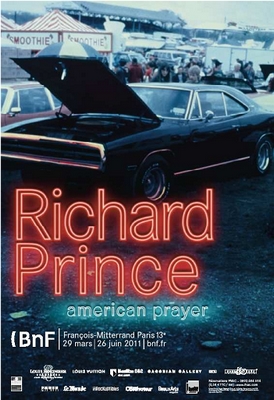
Richard Prince exhibit at BnF in Paris, France - An American Prayer

Richard Prince: An American Prayer 
BnF - Bibliothèque nationale de France, Paris
Curators: Bob Rubin, Marie Minssieux-Chamonard 
March 29 - June 26, 2011


RICHARD PRINCE, American Prayer at BnF - Photograph (c) Richard Prince

AN AMERICAN PRAYER is a book of poems by Jim Morrison, who would have traded rock stardom for recognition as a legitimate artistic figure in a heartbeat. Seven years after his death, “An American Prayer” was the name of a posthumous album of his poetry recorded to music by the remaining Doors. On March 29, “American Prayer,” an exhibition of American literature and ephemera from the collection of American artist RICHARD PRINCE opens at the Bibliothèque nationale de France. Also on view will be artworks by Prince relating to books, an important source of both inspiration and materials for artistic practice, including two never-before-seen examples of his famous “Nurse” paintings from his personal collection.  

In a purpose-built structure meant to evoke the wood-shingled houses of l’amérique profonde, Richard Prince displays 40 of his American / English series (sculptures based on the first American and English editions of his favorite works) with 24 Untitled (original)s, which reunite pulp paperbacks with their original cover art. A selection of Prince artwork which derives from and/or pays homage to the book and the mechanically reproduced image – works from the series Publicities, Gangs, Cartoons, and even Hoods – encircle vitrines with treasures from the most important collection of twentieth-century Americana still in private hands.

(c) Richard Prince / Rob McKeever,
courtesy of Gagosian Gallery

Finally, a “Reading Room” provides a conceptual tour d’horizon of the complex interactions of art and the text in the digital age. The “greatest hits” of the Prince and BnF collections – precious books and manuscripts from the likes of James Joyce and Louis-Ferdinand Celine you can’t touch without getting arrested – are intercut with livres ireel (imaginary books) and iPads stuffed with Prince’s prolific output of artist's books. Part bibliographic exhibition, part art installation, the show toys with the viewer’s preconceived notions of image and text, while presenting a fascinating taxonomy of American subcultures: cowboys, bikers, hoboes, hippies, and spacemen.


(c) Richard Prince / Rob McKeever,
courtesy of Gagosian Gallery


A book collector for nearly forty years, Prince has amassed a remarkable trove of works from what he describes as the “BeatHippiePunk” era: 1949 (the year of his birth) to 1984. It starts with the “Beats” – Kerouac, Ginsberg, and Burroughs, for sure, but also Nabokov (whose personal library relating to Lolita Prince owns) and J.D. Salinger. He has a particular faible for Hunter S. Thompson, whose Hell’s Angels and Fear and Loathing in Las Vegas figure prominently in the mix; the hugely influential underground cineaste Jack Smith; Mario Puzo, whose manuscript for The Godfather will be on display; Truman Capote, whose letters to the convicted murderer Perry Smith are in the collection and Jimi Hendrix, as well as Robert Crumb and Yoko Ono…and of course Thomas Pynchon, Ken Kesey, Tom Wolfe, and Terry Southern. Prince has a special interest in a number of American writers better known and loved in France: Richard Brautigan, Philip K. Dick, Jim Thompson, and Chester Himes. Prince’s holdings of letters include Jimi Hendrix’s handwritten letters home to his father while he was in the army, and, later, on the road with Little Richard’s band; Kerouac’s letters to Malcolm Cowley, editor of On the Road; and a plethora of missives from those two incognito novelists, J.D. Salinger and Thomas Pynchon. 

This would be an amazing aggregation of Americana from Mr. X, but the fact that it comes from Richard Prince is what makes this uniquely interesting. Prince’s collecting and his artistic practices are hard to separate…so why try?


An illustrated CATALOGUE accompanies the exhibition. Published by GAGOSIAN GALLERY in association with the Bibliothèque nationale de France, the catalogue includes text excerpts from many of the aforementioned by books in the artist’s collection as well as essays by exhibition curators Bob Rubin and Marie Minssieux-Chamonard, and rare book collector John McWhinnie.


BNF - BIBLIOTHEQUE NATIONALE DE FRANCE
Quai François Mitterrand
75713 PARIS

05/02/11

David McDermott and Peter McGough, Of Beauty and Being


OF BEAUTY AND BEING, an exhibition of new work by the collaborative artists DAVID MCDERMOTT & PETER MCGOUH is on view at CHEIM & READ, NYC, through February 12, 2011. Their previous show with Cheim & Read was in 2008.

David McDermott and Peter McGough (born 1952 and 1958), are known for their creative appropriation of different historical eras and styles. Faithful to the subjects and techniques of their chosen period, the duo's multi-disciplinary work questions the nature of perception, identity, gender and narrative. Memory and nostalgia play strong roles, subtly subverted by an aura of artificiality and the artists' sly reconstruction of the past.

McDermott & McGough's recent work has looked to cultural tableaus of 1950s and 60s Americana, culling imagery from advertisements, movies and movie stars, comic books and paperback novels. Their current exhibition continues this theme, referencing imagery from 1940s - early 1950s advertisements, geared mostly towards women and a carefully coiffed, artificial world of beauty and desire. In their focus on the archetypal, mid-century American woman, McDermott & McGough construct narrative portraits, still lifes, evocative nudes and cultural and art historical references (one piece, an obvious take on Roy Lichtenstein's Girl with Ball, 1961, is titled Before the Fall, 1955, 2010). 

The images, all photographs, are printed in a tricolor carbon photographic process, a technique perfected and made famous by the photographer Paul Outerbridge in the 1930s and 40s, and used for color advertisements in magazines. Outerbridge, a successful and innovative commercial photographer, as well as an artist, created a scandal with his color photographs of female nudes. McDermott & McGough reference the saturated hues and precise staging of Outerbridge's compositions, as well as his subjects (as in My Song of Love, 1955, 2010 and Haunts My Reverie, 1955, 2010). They also find inspiration in the commercial work of Man Ray and Edward Steichen. The inherent tension between the photographers' commercial and creative careers interest McDermott & McGough. Their advertisements were a direct result of the approach and aesthetic concerns of their artistic output; art then emulated the advertisements. Conceptually, they orient themselves as "advertisers" of a re-imagined past - an idealistic landscape at home in the American subconscious. 

Representing "the struggle of what beauty presents to the individual and the power that it commands," McDermott & McGough recognize the distance between the remote, ultimately "unreal" look of their objectified subject and the contemporary viewer. In Always Reminding Me That We're Apart,1955, 2010, a purple-gloved woman looks at the viewer through her fractured reflection in a compact mirror, reducing her image to a diamond-shaped wedge and further enforcing her remove from the audience - a condition strongly supported by the work's title. The search for one's own identity and existence is modeled by fantasies and daydreams. Desire for beauty is reliant on a pose.

Cheim & Read
547 W 25 NY
USA

www.cheimread.com

08/12/10

Paula Hayes' Botanical Sculptures at MoMA, NYC

Paula Hayes, Nocturne of the Limax maximus
MoMA, Museum of Modern Art, New York
Through February 28, 2011


PAULA HAYES. Installation view at MOMA. 2010

PAULA HAYES. Installation view at MOMA. 2010

PAULA HAYES. Installation view at MOMA. 2010

PAULA HAYES. Installation view at MoMA. 2010
PAULA HAYES. Installation view of Nocturne of the Limax maximus (Slug at left. Egg at right) at The Museum of Modern Art. 2010. Installation: cast acrylic, hand-blown glass, cnc-milled topographical wall and ceiling attachment, full-spectrum lighting, and tropical planting. Commissioned by The Museum of Modern Art, New York. Courtesy of the Artist and Marianne Boesky Gallery. © Paula Hayes. Photo: Jason Mandella

The Museum of Modern Art presents an installation of two sculptures by New York artist and landscape designer PAULA HAYES (b. 1958). The installation NOCTURNE OF THE LIMAX MAXIMUS is on view in the MoMA’s lobby through February 28, 2011. The work includes a fifteen-foot-long, wall-mounted horizontal sculpture called Slug, and a free-standing floor-to-ceiling structure titled Egg. .

The installation is organized by Ann Temkin, The Marie-Josée and Henry Kravis Chief Curator of Painting and Sculpture, The Museum of Modern Art, in collaboration with the artist.


Since the 1990s, PAULA HAYES has produced botanical sculptures—organically shaped vessels made from blown glass, silicone, or acrylic, and filled with a rich variety of plant life—that expand upon the classic terrarium, both through their imaginative containers and the microcosmic universes within. For the MoMA project, Hayes began thinking about the concepts of fertility and fertilization. While working on her initial drawings, she was inspired by a documentary film portraying the intricate mating ritual of the Limax maximus, or Leopard slug (which takes place in early summer, usually during the night), and the fluid columnar forms that emerge during the process of fertilization. Slug and Egg are made in cast acrylic and hand-blown glass, and filled with vegetation. Aided by built-in lighting and weekly maintenance, these “living artworks” bring nature directly into the Museum as they challenge conventional definitions of sculpture.


Recent posts by Paula Hayes on INSIDE/OUT: A MoMA/MoMA PS1 Blog:

"In the Bathysphere"

"Getting to Z (Another Kind of A): "Egg" Acrylic-Casting Process"


The Museum of Modern Art, 11 West 53 Street, New York City, NY 10019

11-17-2010 > 02-28-2011

19/11/10

George Segal: Women – Maxwell Davidson Gallery – Exhibition and Catalog

George Segal: Women
Maxwell Davidson Gallery, New York
Through December 23, 2010

GEORGE SEGAL:WOMEN is George Segal’s first exhibition at Maxwell Davidson Gallery. The gallery is working directly with Carroll Janis and the George and Helen Segal Foundation to present and curate this show. This also represents the first time an exhibition has been devoted solely to Segal’s depictions of the female form – both sculptures and pastel drawings.

Segal emerged as one of the preeminent artists of the Pop era. Along with his contemporaries, Roy Lichtenstein, Andy Warhol, and Tom Wesselmann, Segal combined his considerable artistic abilities with an in-depth understanding of art history to create a vision that was classical in approach, emotional in content, and at the same uniquely his own.

This exhibition is predominantly composed of the plaster cast sculptures for which he is renowned but also includes a series of pastels – all of which depict women. As John Wilmerding writes:

“...Of all Segal’s subjects, perhaps the most moving and haunting were his renderings of women, and the selection here covers the gamut of his inventiveness and range of expression.”

The fully cast forms and fragments in the show make use of various found objects and set pieces, and range in subject matter from erotic to athletic, and mundane to mesmerizing. The pastels are mainly line drawings, but the elegance of their simplicity and the vibrancy of their colors feature Segal’s ability as a draughtsman.


George Segal: Women

GEORGE SEGAL
George Segal: Women
14 Color Photographs with essay by John Wilmerding
$20 - Available at www.davidsongallery.com

November 4, 2010 – December 23, 2010

MAXWELL DAVIDSON GALLERY
724 Fifth Avenue, 4th Floor
New York, NY 10019, USA

05/10/10

Fleeting Glimpse Photography exhibition at Roanoke and Richmond, Virginia: Eleanor D. Wilson Museum and Virginia Museum of Fine Arts

Photography exhibition - The Fleeting Glimpse:
Selections in Modern and Contemporary Photography
from the Virginia Museum of Fine Arts

Eleanor D. Wilson Museum, Roanoke, VA
Through December 4, 2010

Virginia Museum of Fine Arts, Richmond, VA
January 15 - April 3, 2011

LEE FRIEDLANDER, Shadow - New York City, 1968

LEE FRIEDLANDER, Shadow - New York City, 1968. Silver Print, Virginia Museum of Fine Arts, Richmond. The John Barton Payne Fund. Photo: Travis Fullerton, © Virginia Museum of Fine Arts. Image © Lee Friedlander, courtesy Fraenkel Gallery, San Francisco. Recent photographs of Lee Friedlander from America from Car is on view at the Whitney Museum of American Art in New York. And a retrospective of Lee Frielandler work from 1960 to 2010 will be on view at the Fraenkel Gallery.

The Eleanor D. Wilson Museum at Hollins University in partnership with the Virginia Museum of Fine Arts presents The Fleeting Glimpse: Selections in Modern and Contemporary Photography from the Virginia Museum of Fine Arts featuring 35 works by 27 artists using the photographic medium to transform common found occurrences in nature and humanity into unusual encounters and strange juxtapositions.

The Fleeting Glimpse is the first major focus on the Virginia Museum of Fine Arts (VMFA)’s renowned photography collection and marks the first partnership collection-sharing program with the largest museum in the commonwealth. The Fleeting Glimpse is co-curated by Christine Carr, artist and assistant professor of art at Hollins University and Wilson Museum Director Amy Moorefield. The exhibition roster encompasses a group of provocative legends of the camera, both modern and contemporary, and features the work of artists including Berenice Abbott, Diane Arbus, Blythe Bohnen, Judy Dater, Jen Davis, John Divola, Robert Doisneau, Martin Dorbaum, David A. Douglas, Roy DeCarava, Lee Friedlander, Ralph Gibson, Emmet William Gowin, John N. Heroy Jr., Richard Kent Hough, Connie Imboden, Alen MacWeeney, Sally Mann, Ralph Eugene Meatyard, Ray K. Metzker, Joseph Mills, Brian H. Peterson, Hiroshi Sugimoto, Ruth Thorne-Thomsen, Jerry N. Uelsmann, Garry Winogrand, and Willie Anne Wright. 

HIROSHI SUGIMOTO, Byrd Theatre, 1993

HIROSHI SUGIMOTO, Byrd Theatre, 1993. Gelatin Silver Print, Virginia Museum of Fine Arts, Richmond. Gift of the Collector’s Circle. Photo: Travis Fullerton, ©  Virginia Museum of Fine Arts. Image © Hiroshi Sugimoto, courtesy Fraenkel Gallery, San Francisco.


Through exploitation of a variety of photographic techniques including digital (Dorbaum), straightforward (Arbus), long exposure (Divola), vignette (Gowin) and pinhole process (Wright), the artists all share commonalities in the pursuit of a visually fragmented narrative in highly experimental work. The viewer has a “fleeting glimpse” of an implied alternative reality through the artists’ deliberate and sometimes happenstance staging and organization of chance elements. Using the camera, a number of the artists (Sugimoto, Dorbaum) create illusionary portals in their compositions psychologically pulling the viewer into their realms. Other works (Arbus, Doiseau, Imboden) propel the viewer away through the sitters’ carefully staged gazes controlled by the artist’s surface manipulations transforming their features into fractured and dissociated objects.  All entice the viewer with implied psychosomatic drama through bizarre subject matter and compositions inviting further examination.

The approachable medium of photography allows visitors to the exhibition the first “glimpse” of never before seen significant works by extremely well known leading photographers.

The exhibition is accompanied by a full color CATALOGUE with essays by both curators as well as Emily Smith, VMFA Curatorial Fellow.

Organized by the Eleanor D. Wilson Museum  at Hollins University in partnership with the Virginia Museum of Fine Arts. After its inaugural viewing at the Eleanor D. Wilson Museum at Hollins University, The Fleeting Glimpse will be on view at the Virginia Museum of Fine Arts.

Funding for The Fleeting Glimpse comes in part from the City of Roanoke through the Roanoke Arts Commission as well as support from the Virginia Museum of Fine Arts.

Eleanor D. Wilson Museum, Hollins University, Roanoke, Virginia 
09/16 – 12/4, 2010
www.hollins.edu/museum

Virginia Museum of Fine Arts, Richmond, Virginia
www.vmfa.museum

02/07/10

Joshua Mosley: American International. Exhibition at the Indianapolis Museum of Art

Joshua Mosley: American International
Indianapolis Museum of Art
Through August 29, 2010

The Indianapolis Museum of Art (IMA) presents together two animated video and sculpture installations by Philadelphia-based artist Joshua Mosley: A Vue (2004) and the premiere of his newest work, International (2010).

The works presented in Joshua Mosley: American International are composed of mixed-media animations displayed alongside small-scale bronze sculptures of characters that populate the animations. Both International and A Vue consider the memorialization of prominent individuals whose legacies sound ambivalent reverberations when viewed through the lens of contemporary life. Combining the most current technology with the hand-wrought physicality of modeled objects, Mosley’s works explore how the mind can negotiate multiple—often incompatible—points of view, grappling with existence, work and human life.
“Joshua Mosley’s installations stand apart as some of the most inventive, challenging and gratifyingly peculiar artwork being made today,” said Sarah Urist Green, associate curator of contemporary art at the IMA. “Over the course of years and with extensive research, craftsmanship and intricate technological execution, Mosley builds highly original compositions that create space for contemplating how individuals interpret and impact the world.”
In the premiere of Mosley’s first work since dread (2007), which debuted at the 2007 Venice Biennale, the IMA will present International, a video and installation work focusing on two figures who had interminable influence on current American industrial infrastructure and economic theory: Austrian free-market economist and philosopher Friedrich Hayek and American builder and philanthropist George R. Brown, former president of Brown & Root, Inc., purchased by the Halliburton Company in 1962.

International is a two-part installation, the first of which is a character study of Brown and Hayek, whose standing figures Mosley hand-sculpted in clay and rendered in bronze. Each approximately 15 inches tall, the sculptures will be displayed alongside a 34-inch long replica of a 1937 International brand truck, which Mosley hand made from wood, metal and resin and then cast in bronze. Mosley then 3D scanned the truck, creating a digital model that he animated and incorporated into International’s 6-minute highdefinition animation. Displayed in an adjacent gallery, the projected video combines 3D computer animation with recent digital photography of sites of pivotal importance in the lives of Brown and Hayek. The animation features the voices of the two men sampled from oral history recordings made between 1968 and 1978, interwoven with a musical score composed of single notes played on a 1938 Haines Brothers piano, matching one that belonged to Brown's family.

While the two men never met, Mosley’s imagined conversation between Hayek and Brown will turn a keen eye on how the personal desires and experiences of human beings shape the way they imagine the greater good, even among people living in the same place and the same historical moment. In the artist’s words, International explores “how the mind can simultaneously hold incompatible ideas,” and how individuals, like Hayek and Brown, can reconcile public theories and actions with more private motivations. At a moment when the U.S. government is trying to stem a systemic financial crisis, International will look to the pertinent examples of two men, one of whom was a vocal opponent of government intervening in a free market, and another who accumulated considerable wealth as a result of large-scale government spending.

A second video and sculpture installation, A Vue (2004), looks to the legacy of American botanist George Washington Carver. The installation presents a 24-inch bronze sculpture titled George Washington Carver, 150 ft and an animation that chronicles its presence as a large-scale monument in one of the national parks dedicated to Carver. The animated video combines digitally photographed stop-motion puppets and environments made with 3D modeling software and ink-wash paintings. The animation’s narrative follows Henry, a park ranger whose job it is to tend the small town’s 150-foot sculpture of Carver. The viewer sees Henry on his daily task of scaling the monument to polish and clean it, surrounded by the flat, bleached vista of a nondescript Midwestern town. Henry meets Susan, a new employee of the local fiber optic company, and the disparity between the nature of each character’s life’s work is set in witty and compelling contrast.

With Carver’s forward-looking figure presiding over the town, his teachings—sustainability in agriculture, self-sufficiency, humanitarianism—cannot help but be evaluated against this contemporary landscape. Best known for taking the greatest advantage of a series of unlikely opportunities, and eventually developing hundreds of uses for the peanut, Carver helped revolutionize agriculture in the South by offering alternatives to the single-crop cultivation of cotton that had devastated the land. Mosley’s memorials in miniature, of Carver as well Brown and Hayek, serve to question how meaning can become fixed in the consideration of the diverse and often conflicted lives of these enigmatic men.

Short biography of JOSHUA MOSLEY
Joshua Mosley (born 1974, Dallas, lives Philadelphia) is Associate Professor of Fine Arts in the School of Design at the University of Pennsylvania. He received his M.F.A. and B.F.A. from The School of the Art Institute of Chicago and his A.A. from St. Louis Community College. Mosley is a recipient of the Joseph H. Hazen Rome Prize, the Pew Fellowship in the Arts, the Louis Comfort Tiffany Foundation Award and the Pennsylvania Council on the Arts Fellowship. His work has exhibited and screened at the 2007 Venice Biennale, the Museum of Modern Art, New York, the Modern Art Museum of Fort Worth, the Museum für Gegenwartskunst in Basel, Switzerland, the Art Institute of Chicago, the Bruce Museum in Greenwich, CT, the Reina Sofia in Madrid, the Philadelphia Museum of Art, Donald Young Gallery in Chicago, the Institute of Contemporary Art in Philadelphia and the Museum of Contemporary Art San Diego.

INDIANAPOLIS MUSEUM OF ART
Carmen & Mark Holeman Video Gallery and Livia & Steve Russell Gallery
4000 Michigan Road, Indianapolis, Indiana
March 12 - August 29, 2010

Exhibition credit: This exhibition is made possible through the generosity of the Chambers Family Foundation.

05/05/10

Spencer Finch, Amabilis Insania - Nordenhake, Berlin


Spencer Finch, Amabilis Insania
Galerie Nordenhake, Berlin
April 30 - June 5, 2010

Galerie Nordenhake in Berlin presents an exhibition by US artist SPENCER FINCH (born in 1962, lives in New York). The artist conceived new drawings, photographs and a light installation but also a sound installation and a sculpture. Themes uniting the diverse works in the show are the complexities and pleasures of apprehending sensations. Most of the works deal with misperceptions or misapprehensions. They are treated not necessarily as failure but as pleasurable moments hinting at a seeing prior to recognition and rationalisation.

The seduction of misperception is suggested in a group of photographs: in reality representations of cherry blossoms in a pond, they appear as delicate images of clouds in the sky bringing to mind Alfred Stieglitz’ series of abstract photographs “Equivalence”. In another work, the white concrete sculpture sitting directly on the gallery floor recalls a pile of snow. A similar irritation of our perception evokes the sound installation.

The artist maps the limits of his own field of vision in a drawing that compares far peripheral and central vision, but it also contrasts linguistic and visual descriptions of colour. Spencer Finch recorded the colour of a car rushing by on a highway once it appeared in his field of vision and painted his colour impression with pigments on paper. Like a researcher, he adds a written account of the vehicle's actual colour and form. The central vision differs from the perception in peripheral areas of the eye in respect to colour and form and proves it as erroneous.

The uncertainty of perception — that there is more to reality than our bodily senses could register — is implied in the series of eight drawings after false-colour images. The colourful oil pastels look entirely abstract but are in fact truly representational as they render thermograms of the light falling through the window in the artist’s studio over the course of one day.

Spencer Finch is known for a multi-layered artistic practice in which he explores the mechanism and mysteries of perception. Many of his poetic and witty works aim at preserving the memory of a sensorial experience, be it a pile of snow or moonlight in Venice. He bases his unconventional and meticulous representations on extended research and rigorous measurement while his art acknowledges the difference and distance of all representation and reinforces the beauty of the fleeting nature of the observed world.

Spencer Finch's artworks were previously presented in Berlin by Galerie Nordenhake in two exhibitions Spencer Finch: In Praise of Shadows (2007-2008) and Spencer Finch: Prussian Blue (2005).

NORDENHAKE
Gallery's website: www.nordenhake.com

01/10/06

Elliott Erwitt Six Decades

© Elliott Erwitt - All rights reserved

"Elliott has to my mind achieved a miracle working on a chain-gang of commercial campaigns and still offering a bouquet of stolen photos with a flavor, a smile from his deeper self."
Henri Cartier-Bresson
Andrew Smith Gallery opens an important exhibit titled Six Decades by internationally renowned photographer Elliott Erwitt, with an opening reception and booksigning for the artist on Friday, October 13, 2006 from 5-7 p.m. Erwitt's photographs of ordinary life, beach scenes, celebrities, children and dogs have delighted viewers for decades. At age 78 he has culled through sixty years of work and chosen what he considers to be his very best photographs. Many have never been published before. These ebullient images reflect the vast scope of the wittiest photographer of our time.
Andrew Smith Gallery will have approximately 25 of Erwitt's classic photographs representing many phases of his long career. During the opening Elliott Erwitt will be signing copies of his newest book, Personal Best (teNeues, 2006). The exhibit continues through November 20, 2006.
Erwitt's superb sense of humor coupled with a deceptively casual photographic technique inspired the eminent photography critic, John Szarkowski, to remark that Erwitt is "one of the few photographers whose work is also identified by extraordinary wit." Traveling around the world on magazine assignments, Erwitt always found time to take the wry and timeless photographs of ordinary people and dogs that have made him famous. His photographs of Hollywood legends like Marlene Dietrich and Marilyn Monroe, and political figures like Nikita Khrushchev and Richard Nixon are equally penetrating and insightful.
According to writer, Sean Callahan, survival seems to be built into Erwitt's nature, along with the ability "to be an astute observer of others, highly sensitive to the vicissitudes of life and, when necessary, utterly charming and disarming." Erwitt was born in Paris in 1928, the only child of displaced Russian parents who raised him in Milan. When he was 11 the family fled Europe on the last boat out of free France. For several years he and his parents lived in New York City before moving to California. At age 16, after his parents split up, Erwitt was on his own in Los Angeles, attending Hollywood High while living in a rented bungalow with friends. After Edward Steichen arranged his first commercial job he established himself in New York the 40s and 50s as a leading magazine photographer. His friendship with Robert Capa resulted in his joining the prestigious Magnum Agency in 1953 after he got out of the army.
In his long and successful career as a magazine and advertising photographer Erwitt has used an arsenal of cameras. But the images he shot for himself were usually made with a classic Leica rangefinder and in black and white. He has remarked, "The most important advice to photographers is f:8 and be there." In his most poetic images something wordless and magical happens in a fleeting instant. In Orleans, France, 1952 Erwitt snapped the shutter just as a pigeon fluttered down to a deserted cobblestone street illuminated by a triangular shaft of sunlight.
Erwitt has shot annual reports of Fortune 500 companies, worked on six-figure advertising campaigns for Madison Avenue, and on breaking news for Paris Match. An assignment shooting women's shoes inspired him to take a closer look at dogs as subjects. New York City, 1974, one of Erwitt's most famous photographs, was taken with the camera near sidewalk level of a bug-eyed, rat-sized dog dressed in a knitted sweater and hat standing next to two gigantic pairs of legs, one wearing boots, the other belonging to another dog. The humor lies in the somewhat idiotic expression of the tiny dog which suggests it is the dwarfed product of a canine/human marriage.
In Erwitt's classic image, California, 1955, the reflection of a couple kissing in a parked car's side mirror is like a joyful bubble against a Pacific ocean sunset.
In 1960, on the set of the movie The Misfits, Erwitt photographed a team that included Marilyn Monroe, Clark Gable, Montgomery Clift, Arthur Miller, John Huston, and Eli Wallach. The cast looks a little haggard, and even Monroe struggles to play her diva role. It was the last film either Gable or Monroe would make before their deaths. Erwitt said of Monroe, "Physically she was surprisingly unattractive; the beauty was manufactured. But she was extremely intelligent and sensitive. And likeable."
In 2006 several touring exhibitions of Erwitt's photographs were shown at New York's International Center for Photography, in Paris, at Japan's Mitsukoshi, and in Barcelona, Spain. Additionally, a major exhibition in Australia is being planned. His photographs have been collected and exhibited at museums including the Museum of Modern Art, New York, the Smithsonian Institution, the Art Institute of Chicago, the Museum of Modern Art in Paris, and the Kunsthaus in Zurich. His photographic books include the comprehensive monograph Personal Exposures/Elliott Erwitt (Norton, 1988); On the Beach (Norton, 1991), and Elliott Erwitt: To the Dogs (Norton, 1992). Elliot Erwitt currently lives in New York City.
Liz Kay
Andrew Smith Gallery - 203 W. San Francisco St. Santa Fe, NM 87501
www.andrewsmithgallery.com

01/09/06

Rhona Bitner Photographs Stage

In the series called Stage, Rhona Bitner goes further in her observation of the live show and transcends the interface between photography and theatricality. After working on circus and its actors in the Circus (1991-2001) and Clown (2001-2002) series the artist moves from the sandy circus ring to the worn-out stage floor. Now she no longer focuses on the people who make the show but instead on the very place where the show takes place: the stage. When empty, it is the very essence of theatre as a space for representation unfolding its own vocabulary: a unique decorum made of drapes, crimson velvet curtains, choreographed bunches of spotlights, colossal centre lights, a deep, heavy, silent and unsettling darkness.
. Rhona Bitner focuses on both the few moments opening the show and the seconds closing it. The lights in the room have been turned off, the stage is bathed in the light of the spots, the members of the audience are holding their breath and the actors are about to appear on the stage.
. In this big format series, the artist unveils the poetic and intense dimension to theatre as a space for experiences in view of the various human perceptions that photography tries to capture.
. Rhona Bitner lives and works in New York. In Paris she is represented by Galerie Xippas, in Boston by Howard Yezerski Gallery and in New York par CRG Gallery. Her photographs appear in the collections of the New York Whitney Museum of American Art, of the Fonds National d'Art Contemporain in Paris, of the Maison Européenne de la Photographie in Paris.
. BFAS Blondeau Fine Arts Services will present 14 photographs by Rhona Bitner during the upcoming common opening with the “quARTier des Bains” galleries group in Geneva on September 14, 2006.
. A catalogue will be published before the end of the year in collaboration with Galerie Xippas, Paris, who presented this series in May-June 2006.
. BFAS - Blondeau Fine Art Services - 5, rue de la Muse - CH-1205 Genève Exhibition: THU-FRI 14h-18h30 and SAT 11h-17h