Showing posts with label illustrator. Show all posts

11/11/25

R. Crumb @ David Zwirner, Los Angeles - 'Tales of Paranoia' Exhibition

R. Crumb: Tales of Paranoia
David Zwirner, Los Angeles
October 10, 2025 – January 10, 2026

Panel from Robert Crumb
Panel from R. Crumb, I'm Afraid, 2025
© Robert Crumb, 2025 
Courtesy the artist, Paul Morris, and David Zwirner

David Zwirner presents an exhibition of new drawings and prints by iconic illustrator and cartoonist R. Crumb (b. 1943), on view at the gallery’s 616 N Western Avenue location in Los Angeles. In his works of the last several years Crumb reflects on life in his eighties and his sixty-year career as well as themes of personal and mass paranoia during these times of social and political unrest. Crumb’s most mordant attacks are, as always, reserved for himself and show him contending with his own manic anxieties in a humorous and insightful manner.

The new works in this exhibition represent Crumb’s first extensive solo comic work in over two decades, marking an impressive late-career resurgence. Many of these incisive, introspective, and formally adventurous illustrations were made for the artist’s publication, Tales of Paranoia. This new comic book—Crumb’s first in twenty-three years—was published this month by Fantagraphics. Created in the wake of the 2022 passing of Crumb’s wife and longtime artistic partner, Aline Kominsky-Crumb, these works reveal a mind turning inward without its usual counterpoint—absent her grounding presence, the work veers further into obsessive, unfiltered reflection. As Crumb noted in 2019, “Success and the love of real women helped me a lot. Aline really saved my dismal ass.” [1] Crumb and Kominsky-Crumb had frequently collaborated, particularly in the decade preceding her death, and her absence is felt directly in the content of these recent works.

While Crumb’s early work skewered both mainstream and countercultural figures with a hyper-libidinal, satirical edge, his recent drawings meditate on paranoia, particularly around medicine and disease. These works convey a heightened self-awareness, oscillating between genuine suspicion and conspiracy; they incisively mirror a broader culture of mistrust of authority and the erosion of shared meaning and reliable information in the world today. In A Difficult Conundrum (2025), each panel depicts an increasingly agitated Crumb, his speech bubbles multiplying in a spiraling monologue directed against a pharmaceutical company. Through the familiar conventions of the comic form, Crumb constructs a self-portrait steeped in uncertainty and vulnerability. In other works he revisits his past, exploring difficult and disturbing moments that continue to affect him. As the title suggests, The Very Worst LSD I Ever Had (2025) documents a harrowing acid trip that Crumb experienced in 1966, which led him to seek several sessions of regressive hypnosis.

Also on view is a rare sketchbook from earlier in Crumb’s career, which offers an intimate glimpse into Crumb’s process and preoccupations. Placed in dialogue with the recent drawings, it highlights not only the evolution of the artist’s style and tone but also the enduring idiosyncrasies—formal, psychological, and narrative—that continue to define his work. Numerous recent etchings Crumb produced in collaboration with the renowned print studio Two Palms, New York, are also featured.

Artist R. Crumb

Born in Philadelphia, R. Crumb (b. 1943) moved to the dynamic Haight-Ashbury neighborhood of San Francisco in 1967, and relocated in 1991 to the south of France, where he currently lives and works. Crumb joined David Zwirner in 2006. This is Crumb’s seventh solo exhibition with the David Zwirner gallery.

Solo exhibitions of Crumb’s work were presented at the Contemporary Art Galleries, University of Connecticut, Mansfield (2020), and at the Museum of Contemporary Art Santa Barbara, California (2018). In 2016, the Cartoonmuseum Basel organized Aline Kominsky-Crumb & Robert Crumb: Drawn Together, the first comprehensive museum presentation of the artists’ joint work. A retrospective of Crumb’s work was held in 2012 at the Musée d’Art Moderne de la Ville de Paris. In 2011, his work was the subject of a solo exhibition at the Museum of American Illustration at the Society of Illustrators, New York. A major solo show devoted to Crumb’s work was organized by the Yerba Buena Center for the Arts, San Francisco, in 2007, and traveled from 2008 to 2009 to the Frye Art Museum, Seattle; Institute of Contemporary Art, Philadelphia; Massachusetts College of Art and Design, Boston; and the Grand Central Art Center, Santa Ana, California. Other solo exhibitions of the artist’s work have been organized by the Whitechapel Gallery, London, a show that traveled to the Museum Boijmans Van Beuningen, Rotterdam (both 2005); and Museum Ludwig, Cologne (2004). Terry Zwigoff’s documentary Crumb was named the best film of 1994 by the late critic Gene Siskel and won the Grand Jury Prize at the Sundance Film Festival in 1995

Work by the artist is represented in major museum collections worldwide, including the Brooklyn Museum, New York; Carnegie Museum of Art, Pittsburgh; Lucas Museum of Narrative Art, Los Angeles; Musée régional d'art contemporain Occitanie, Sérignan, France; Museum Ludwig, Cologne; and The Museum of Modern Art, New York.

[1] Nadja Sayej, “Robert Crumb: ‘I am no longer a slave to a raging libido’,” The Guardian, March 7, 2019. Accessed online.

DAVID ZWIRNER, LOS ANGELES
616 N Western Avenue, Los Angeles, CA

01/02/25

Draw Them In, Paint Them Out: Trenton Doyle Hancock Confronts Philip Guston @ Jewish Museum, New York

Draw Them In, Paint Them Out 
Trenton Doyle Hancock Confronts Philip Guston
Jewish Museum, New York
Through March 30, 2025

TRENTON DOYLE HANCOCK
"Schlep and Screw, Knowledge Rental Pawn Exchange Service," 2017 
Acrylic and mixed media on canvas, 
60 x 60 x 6 in. (152.4 x 152.4 x 15.2 cm) 
Collection of Hedy Fischer and Randy Shull, 
Asheville, North Carolina

Draw Them In, Paint Them Out: Trenton Doyle Hancock Confronts Philip Guston examines Philip Guston’s seminal influence on Trenton Doyle Hancock and both artists’ shared commitment to investigating the legacy of white supremacism in the United States. The exhibition presents the the work of painter PHILIP GUSTON (American, b. Canada 1913–1980), the child of Jewish immigrants from Odessa (present-day Ukraine), and TRENTON DOYLE HANCOCK (American, b. 1974), a leading Black contemporary artist based in Houston, Texas, in dialogue for the first time. The exhibition explores resonant connections between their work and the role that artists play in the pursuit of social justice.

Organized by the Jewish Museum, the exhibition features key works by Philip Guston including his now iconic, late satirical Ku Klux Klan paintings in dialogue with major works Trenton Doyle Hancock created in response to his inspirational mentor, highlighting their parallel thematic explorations of the nature of evil, self-representation, otherness, and art activism. Foregrounding works that depict the Klan, the exhibition demonstrates how both artists engage with and at times even inhabit these hateful figures to explore their own identities and more broadly examine systems of institutionalized power and their feelings of complicity within them. Yet, despite the difficult subject matter and at times violent imagery presented in their work, both Hancock and Guston share an ability to conquer the pain and emotion of their art through humor that is both dark and undeniable, engaging with their shared embrace of the visual language of comics.

Philip Guston, whose early social realist and abstract work ultimately evolved into an idiosyncratic form of social satire, is now one of the most revered painters of the twentieth century. Significant examples of Guston’s buffoonish Klansmen paintings and drawings from the late 1960s and early 1970s, selected by Hancock, will be a centerpiece of the exhibition. Guston’s cartoonish style was used to defy the Klan’s bigotry as racial tensions roiled America—tensions that continue to resonate with renewed urgency today. Guston also used the hooded figure as an alter-ego wrestling with his Jewish identity and his assimilation into American culture. This phenomenon is illustrated especially in Guston’s masterful The Studio (1969), which depicts the artist as a Klansman painting a self-portrait, acknowledging his own complicity with white supremacy. 

For the eclectic artist, cartoonist, and illustrator Trenton Doyle Hancock, Guston’s work has been a consistent source of inspiration for nearly 30 years. His collaged psychedelic canvases similarly draw on the language of comics to challenge and comment upon the American condition. The exhibition includes Hancock’s surreal graphic memoir that interweaves Guston’s biography with his own family tree and reports of Klan activity in the United States, past and present. Titled Epidemic! Presents: Step and Screw! (2014), the series has since developed into a substantial body of work in which Hancock’s long-standing avatar, a Black superhero named Torpedoboy, meets and engages with Guston’s Klan-hooded alter-ego. Through this series, Hancock confronts his artistic forefather and examines their respective motivations for grappling with white supremacism in their art.

Draw Them In, Paint Them Out builds upon the Jewish Museum’s ongoing commitment to exploring contemporary art in real time, providing a platform for each new generation of artists. The Museum also shares a foundational history with Guston’s work including the artist’s solo exhibition in 1966, just before the emergence of his late Klan imagery, and his seminal role in Action/Abstraction: Pollock, de Kooning, and American Art, 1940-1976 on view in 2008. The current exhibition joins a fall program at the Museum that tells complex stories from multiple points of view to spark dialogue around how society engages with and learns from historical narratives. By addressing complex and often painful histories, these stories offer opportunities to create a sense of unity around shared experiences and inspire hopeful paths toward the future.

The exhibition is organized in four thematic sections:

Co-Conspirators

The first section examines Guston’s and Hancock’s first forays into Klan imagery, produced in their young adulthoods. This gallery includes Guston’s Drawing for Conspirators (1930), a troubling image of the aftermath of a lynching that speaks to the toll of white supremacy in the United States. Guston’s mural of another lynching scene (c. 1931), painted for the John Reed Club to commemorate the plight of the Scottsboro Boys, is presented in facsimile form, as the original work was destroyed by the Los Angeles police and the KKK.

Guston’s early, politically motivated works will be presented alongside Hancock’s representations of Loid, a fictitious ghost of a 1950s Black sharecropper who appears as half Klansman, half Klan victim, conceived by the artist around the time of his discovery of Guston’s work in the mid-1990s. This harbinger of vengeance, portrayed with a white sheet and noose and wielding a hammer of justice, first emerged in a photographic self-portrait (Properties of the Hammer, 1994) by Hancock at the age of 19, and has recurred in various iterations in drawings (Judgment #2, 2000), cartoons, and paintings (Coloration Coronation, 2016) to the present day.

K-K Kan I Help You?

This next section features a selection of significant late Klansmen paintings and drawings by Guston, including The Studio (1969) and Riding Around (1969). These works represent Guston’s renewed exploration of the Klan, an exercise in both social satire and self-condemnation, following a resurgence of Klan activity in response to the advancements made by the civil rights movement in the United States.

This section also features Hancock’s Epidemic! Presents: Step and Screw! (2014), the graphic series created by Hancock “as a kind of one-liner: what would happen if my alter-ego Torpedoboy met Philip Guston’s alter-ego, the Klansman?” Step and Screw! marks the first time Hancock dealt explicitly with his and his family’s personal ties to America’s haunted past. In 30 black-and-white panels, Hancock contrasts the dark comedy of his comic strip with a fantastical timeline that blends Guston’s and Hancock’s life stories and delves into their generational traumas.

Conception and Execution

The third section of the exhibition focuses on Hancock’s paintings that grew out of Step and Screw! The majority of these mixed media works, which fuse image and text and recombine elements from the original comic book, focus on the “pregnant” moment of exchange between the Klansman and Torpedoboy. In each new iteration, the characters engage in a dubious handoff, with the hooded figure offering the skeptical superhero an object associated with wisdom, be it a lightbulb, an apple, or a head. Works on view include Step and Screw: The Star of Code Switching (2020) from the Jewish Museum’s collection, in which the Klansman offers a talisman so powerful that Torpedoboy’s racial transformation is instantaneous and Lights Out (2023), in which Torpedoboy ends his tenuous affinity with the Klansman, enacting a symbolic patricide.

The Ladder of Coincidence

The final section of the exhibition serves as a coda to the presentation with a single pair of monumental paintings, Guston’s The Ladder (1978) and Hancock’s The Former and the Ladder or Ascension and a Cinchin' (2012). These works illustrate the “umbilical connection” that Hancock has described feeling toward his predecessor, and how Guston’s influence and imagery have subconsciously found their way into many facets of Hancock’s work.

This exhibition is organized by Rebecca Shaykin, Curator, The Jewish Museum, in partnership with Trenton Doyle Hancock

A lavishly illustrated companion volume, co-published with Yale University Press and designed by the award-winning firm Morcos Key, features a lead essay by curator Rebecca Shaykin, with additional contributions by Trenton Doyle Hancock, the veteran curator and noted Black American art scholar Valerie Cassel Oliver, and the celebrated American Jewish comic artist Art Spiegelman. The texts offer multiple perspectives on the current political moment and the ways in which art, popular comics, personal narrative, and humor can deepen our understanding of Black and Jewish experiences in the United States. The book is available worldwide. 

JEWISH MUSEUM, NEW YORK
1109 5th Avenue at 92nd Street, New York, NY 10128

Related posts: 

Philip Guston. SingularitiesHauser & Wirth Zurich , 7 June – 7 September 2024 

Philip Guston Now, National Gallery of Art, Washington, DC, March 2 – August 27, 2023 

Philip Guston - Late Paintings, Peder Lund, Oslo , September 20 - November 8, 2014 

Philip Guston: Works on Paper, The Morgan Library & Museum, New York, May 2 - August 31, 2008

Philip Guston: Mind and Matter, McKee Gallery, New York, November 11 - December 23, 2003

Draw Them In, Paint Them Out: Trenton Doyle Hancock Confronts Philip Guston
Jewish Museum, New York - November 8, 2024 - March 30, 2025

05/05/24

Charles Jeffrey LOVERBOY Exhibition @ Somerset House, London

Charles Jeffrey LOVERBOY 
Somerset House, London 
8 June – 1 September 2024 

Somerset House presents the first ever UK exhibition of Glaswegian born designer, illustrator, stylist, radical creative, and Somerset House resident Charles Jeffrey – celebrating 10 years of his fashion house LOVERBOY. The exhibition examines Charles Jeffrey’ sensational impact on the global fashion scene, from club to catwalk, and includes the full spectrum of his prolific output, with newly commissioned works.

Charles Jeffrey is one of Somerset House Studios’ original resident artists - whose studio is still based within Somerset House’s community of cultural innovators. He graduated from London’s Central Saint Martins in 2015, founding his own fashion label Charles Jeffrey LOVERBOY shortly thereafter. It was named after the cult club night he had hosted weekly in East London to fund his studies and an internship in the haute couture ateliers of Christian Dior in Paris.

The exhibition is anchored by the collaborative spirit nurtured during Charles Jeffrey’s time at art school and that now sits at the root of his gender-inclusive brand’s narrative. Championing wearability and style for all, with fans including Harry Styles and Tilda Swinton, LOVERBOY has been lauded for ripping up the fashion rule book, and transcending the boundaries of art, design and music. Merging traditional tailoring with a punk ethos, its collections are both distinctly contemporary and yet also grounded in British subcultural traditions. With its colourful and cutting-edge designs, Charles Jeffrey LOVERBOY champions self-expression and artistry – a voice that is threaded throughout his work across mediums and the decade.

The exhibition is displayed across three rooms within Somerset House. It includes artistic collaborations, films, illustration, painting, memorabilia, and never-before-seen material. Through a series of sensorially-led spaces rendered in LOVERBOY’s signature playful style, the exhibition  provides an accessible and engaging insight into creative production and the fashion industry. It also provides the space to celebrate a new generation of young London creatives. 

Each room has its own distinctive vision. Presented with an immersive multimedia installation, assembled from the LOVERBOY archive, the exhibition showcases Charles Jeffrey’s creative process across each space. The first room introduces his artistic inspirations, followed by a closer look into the development of his craft and codes, culminating in the final room featuring the brand’s most iconic and extravagant designs. It will be an engrossing insight into Charles Jeffrey’s journey and an opportunity to see his designs up close like never before.

Designer Charles Jeffrey said:
“I’m so excited to have this moment to share my journey in fashion at Somerset House. It's not just about celebrating 10 years of Loverboy; it's about sharing our approach to fashion; being creative, approachable, and not taking ourselves too seriously.”

We're here to shine a light on what we've built and to show that if we can do it, so can you. Visitors can expect to see our journey, our quirks, and have a good laugh along the way. It's about making fashion accessible and fun, reminding everyone that at the end of the day, it's about expressing who you are.”
LOVERBOY is a creative force springing forth from the mind of Scottish Creative Director and Designer, Charles Jeffrey. Based in London – in the catacombs of historic Somerset House, to be exact – LOVERBOY continues to build on its stellar start in the fashion industry, taking on new challenges and reaching new customers year on year. From humble beginnings in Charles’s East London bedroom, LOVERBOY is now an international fashion powerhouse, carried in over 90 stores across the world, and employing a team of ten full-time staff. Drawn to the inherent magic in queerness, Charles and his collaborators create fashion dreamscapes, adding new layers to the brand’s story with each passing season. Together they weave the folkloric thread of Scottish history into the rich tapestry of London’s queer nightlife and music scenes.

A radical sensibility informs all LOVERBOY’s output, and the brand is proudly committed to making clothes that can be worn by anyone, in any conceivable way. With LOVERBOY entering its eighth year, Charles and his team of fashion visionaries are taking this approach to new heights, drawing inspiration from art, music and unconventional sources of queer joy. Renewed connection to nature, the body and notions of queer wellness are all key creative stimuli in LOVERBOY’s current future-facing phase. The brand will also continue to renew its focus on collaboration through partnerships with artists in residence who act as contributors to the design process. 


SOMERSET HOUSE
Strand, London, WC2R 1LA

22/02/19

Maira Kalman @ High Museum of Art, Atlanta

The Pursuit of Everything: Maira Kalman’s Books for Children
High Museum of Art, Atlanta
June 22 - September 15, 2019

This summer, the High Museum of Art will premiere “The Pursuit of Everything: Maira Kalman’s Books for Children,” a colorful exhibition exploring the extensive catalog of Maira Kalman’s imaginative stories and illustrations, which have delighted readers of all ages for more than 30 years.

Perhaps best known for her quirky New Yorker magazine covers and brilliant pictorial essays, Maira Kalman (American, born 1949) has published more than a dozen books for adults and 18 acclaimed children’s books, beginning with the game-changing picture book “Stay Up Late” (1985), which gave visual form to the famous Talking Heads song from the album “Little Creatures.” Since then her works have followed the comic adventures of beloved characters, including a poet dog named Max Stravinsky and Pete the dog, and have addressed important historical people and events with books including “Looking at Lincoln” (2012) and the 9/11-inspired “Fireboat: The Heroic Adventures of the John J. Harvey” (2002).

“The Pursuit of Everything” provides an immersive panorama of Maira Kalman’s picture-book career spanning three decades. The more than 100 works on view will include original drawings and paintings from award-winning books including “Smartypants” (2003), about gluttonous canine Pete’s classroom antics, and “Next Stop Grand Central” (2001) as well as newer publications, among them “Bold & Brave: Ten Heroes Who Won Women the Right to Vote” (2018), authored by U.S. Senator Kirsten Gillibrand, and the illustrated cookbook “Cake” (2018), written in collaboration with the food writer Barbara Scott-Goodman.

Maira Kalman’s stories weave a curious web of familiarity and imagination with illustrations that celebrate the visual splendor of everyday subjects through a lens that is all her own. Her books ignite curiosity and invite young readers to engage deeply with the world around them. Known for her surreal imagery, Maira Kalman expertly combines sophisticated and hilarious text with beautifully rendered pictures, readily acknowledging the interplay between her writing and painting practice. Her stories have deeply personal roots featuring characters, settings and story lines drawn from the artist’s life and whimsical imagination. Maira Kalman’s images reveal a profound curiosity about shared history and the human experience through themes of adventure, exploration, friendship, dreams and the search for meaning.

Maira Kalman paints with gouache on paper, favoring flat, highly saturated planes of color and an idiosyncratic use of space that imbue her works with surprises that will delight and excite the young and the young at heart. The exhibition will offer the opportunity for a different and satisfyingly intimate experience of Kalman’s art.

Maira Kalman says of her wide-ranging work, “The best children’s books are as appealing to adults as they are to children. There have to be different levels of humor, different levels of reference, which allow a dialogue between adults and children. If you live with children, the kinds of conversations you have during the day range from the surreal to the mundane to the insane to the pedantic. And that language can be duplicated in writing because the world is all of those things.”

“The Pursuit of Everything” marks the High’s fourth collaboration with The Eric Carle Museum of Picture Book Art, which organized the show and will present it in Amherst, Mass., from October 13, 2019, through January 19, 2020.

“We are thrilled to partner again with the High to bring children’s picture book art to Atlanta,” said Ellen Keiter, chief curator at The Carle. “Kalman is an astute chronicler of our time as well as someone who makes history accessible. Museum visitors will revel in her lively imagery and witty observations, which vacillate between the comic and the profound.”

“Both captivating and moving, Kalman’s work challenges all of us to rediscover the childlike curiosity that lives deep down inside,” said Virginia Shearer, the High’s Eleanor McDonald Storza director of education. “We are delighted to welcome families back to the High for another exhibition that highlights the work of an acclaimed author and illustrator, and we’re honored to continue our multiyear collaboration with our colleagues at The Eric Carle Museum, who are such wonderful partners.”

In addition to original works from her books, also on view will be Maira Kalman’s illustrated correspondence with her two-year-old granddaughter Olive, fascinating personal notebooks, a colossal reproduction from New York’s Grand Central Terminal, manuscripts, dummy books and other ephemera, including Kalman’s collection of crazy-named candy bars arranged as haikus. The galleries will also feature sketches and images of Kalman’s pictorial essays and covers for The New Yorker.

To bring the audience closer to her artistic process, Maira Kalman repainted the opening scene from her Mikado-themed book “Sayonara, Mrs. Kackleman” (1989) expressly for the exhibition, and she will also create an installation of photographs and objects that inspire her, similar to the one in her studio.

“It is such a wonderful thing to meet a gifted illustrator or a talented writer, and Maira happens to be both,” said Jane Bayard Curley, the exhibition curator. “She is just like her work: funny, smart, and an undisputed champion for the universal appeal of the picture book. Her highly personal and somewhat eccentric worldview appeals to anyone who wants to be verbally and visually amused and challenged.”

Key works featured in the exhibition will include:

- Four hilariously surreal paintings from Kalman’s first picture book, “Stay Up Late,” a collaboration with David Byrne pairing Maira Kalman’s paintings with the lyrics to the popular Talking Heads song
- An early self-portrait of the artist at age 7 sitting in a tree in Henry Hudson Park, from “Chicken Soup, Boots”
- A series of lovingly rendered portraits illustrating the adventures of Maira Kalman’s beloved dog Pete
- Preliminary sketches and finished paintings from Maira Kalman’s popular book series featuring her alter ego, Max the poet dog
- Delicate yet powerfully moving portraits of Sojourner Truth and Inez Milholland from “Bold & Brave: Ten Heroes Who Won Women the Right to Vote,” Maira Kalman’s recent collaboration with U.S. Senator Kirsten Gillibrand.

In conjunction with the exhibition, the Alliance Theatre at The Woodruff Arts Center, of which the High is also an arts partner, will present the world premiere play “Max Makes a Million,” from June 20 to July 21, 2019. Poetry, dance, jazz, visual art and dreams coalesce in this theatrical adaptation combining Kalman’s most notable books, adapted and directed by Liz Diamond.

This collaboration is the fourth in a series presented by the High and the Alliance Theatre in partnership with The Eric Carle Museum of Picture Book Art. The Kalman project follows the successful exhibition and theatre productions based on the work of children’s book authors and artists Ashley Bryan (2017), Eric Carle (2016) and Mo Willems (2015). The presentations are made possible through a grant to The Woodruff Arts Center from the Lettie Pate Evans Foundation to expand programming and increase access for family audiences.

“The Pursuit of Everything” will be presented on the lobby and second levels of the High’s Anne Cox Chambers Wing.

ABOUT MAIRA KALMAN

Born in 1949 in Tel Aviv, Israel, Maira Kalman moved to Riverdale in New York’s Bronx borough with her family at age four. Now a Manhattan resident, Kalman has written and illustrated 18 children’s books, including “Ooh-la-la (Max in Love),” “What Pete Ate,” “Fireboat: The Heroic Adventures of the John J. Harvey,” “13 Words” (a collaboration with Lemony Snicket), “Why We Broke Up” (with Daniel Handler), “Looking at Lincoln” and “Thomas Jefferson: Life, Liberty and the Pursuit of Everything.”

She is a frequent contributor to The New Yorker magazine and is well known for her collaboration with Rick Meyerowitz on its “New Yorkistan” cover in 2001. Additional projects include illustrating Strunk and White’s classic “The Elements of Style.” Kalman also created two monthly online columns for The New York Times. The first, “The Principles of Uncertainty” (2006–07), was a narrative journal of her life. The second, “And the Pursuit of Happiness” (2009), was a yearlong exploration of American history and democracy. Both columns are now collected in book form, published by the Penguin Press.

Since 2003, Maira Kalman has had eight exhibitions at the Julie Saul Gallery in New York City, which represents her work. In 2010, The Institute of Contemporary Art, Philadelphia, organized a retrospective of Kalman’s work titled “Maira Kalman: Various Illuminations (of a Crazy World),” which traveled to the Contemporary Jewish Museum (San Francisco), the Skirball Cultural Center (Los Angeles) and the Jewish Museum in New York. Her work has appeared in books published by The Museum of Modern Art and the Cooper-Hewitt, National Design Museum, in connection with 2014 exhibition “Maira Kalman: My Favorite Things.” Her longstanding contributions to literature, art and design lent her the opportunity to serve as a resident at the American Academy in Rome and to present two renowned TED talks in 2007 and 2014. With her son Alex, Kalman co-curated the exhibition “Sara Berman’s Closet,” which debuted at The Metropolitan Museum of Art and is now traveling to other museums.

Exhibition Organization and Support: “The Pursuit of Everything: Maira Kalman’s Books for Children” is organized by The Eric Carle Museum of Picture Book Art, Amherst, Massachusetts. Support for the High Museum’s presentation is provided by the Lettie Pate Evans Foundation. This exhibition is made possible by Exhibition Series Sponsors Delta Air Lines, Inc., and Turner; Premier Exhibition Series Supporters the Antinori Foundation, Sarah and Jim Kennedy, and Louise Sams and Jerome Grilhot; Benefactor Exhibition Series Supporter Anne Cox Chambers Foundation; Ambassador Exhibition Series Supporters Tom and Susan Wardell and Rod Westmoreland; and Contributing Exhibition Series Supporters the Ron and Lisa Brill Family Charitable Trust, Lucinda W. Bunnen, Corporate Environments, Marcia and John Donnell, W. Daniel Ebersole and Sarah Eby-Ebersole, Peggy Foreman, Robin and Hilton Howell, Mr. and Mrs. Baxter Jones, and Margot and Danny McCaul. Additional support is provided by 2018 Grandparents Circle of Support members Spring and Tom Asher, Anne Cox Chambers, Ann and Tom Cousins, Sandra and John Glover, Shearon and Taylor Glover, Sarah and Jim Kennedy, and Jane and Hicks Lanier and by Lavona Currie, Nena Griffith, Ellen and Tom Harbin, and Margaretta Taylor. Generous support is also provided by the Alfred and Adele Davis Exhibition Endowment Fund, Anne Cox Chambers Exhibition Fund, Barbara Stewart Exhibition Fund, Marjorie and Carter Crittenden, Dorothy Smith Hopkins Exhibition Endowment Fund, Eleanor McDonald Storza Exhibition Endowment Fund, The Fay and Barrett Howell Exhibition Fund, Forward Arts Foundation Exhibition Endowment Fund, Helen S. Lanier Endowment Fund, Isobel Anne Fraser–Nancy Fraser Parker Exhibition Endowment Fund, John H. and Wilhelmina D. Harland Exhibition Endowment Fund, Katherine Murphy Riley Special Exhibition Endowment Fund, Margaretta Taylor Exhibition Fund, RJR Nabisco Exhibition Endowment Fund, and Dr. Diane L. Wisebram.

HIGH MUSEUM OF ART
1280 Peachtree St NE, Atlanta, GA 30309
www.high.org

25/03/18

Martha H. Kennedy, Drawn to Purpose: American Women Illustrators and Cartoonists, 2018

Drawn to Purpose: American Women Illustrators and Cartoonists
University Press of Mississippi in association with the Library of Congress
March 2018

Martha H. Kennedy
Drawn to Purpose: American Women Illustrators and Cartoonists
Foreword by Carla Hayden
Published by University Press of Mississippi 
in association with the Library of Congress
Book cover courtesy of the Library of Congress

A new book presents a survey of the often-neglected artistic achievements of women in cartooning and illustration, featuring more than 250 color illustrations, comic strips and political cartoons, including original art from the collections of the Library of Congress. In “Drawn to Purpose: American Women Illustrators and Cartoonists,” Martha H. Kennedy, curator of popular and applied graphic art, presents a comprehensive look at the trailblazing artists whose work was long overlooked in the male-dominated field from the late 19th century into the 21st century.

“Drawn to Purpose” was published in March 2018 by University Press of Mississippi in association with the Library of Congress. It is the first overarching survey of these art forms by women in the Library’s collection. The book accompanies the Library’s exhibition “Drawn to Purpose” featuring original works by women cartoonists and illustrators.

“‘Drawn to Purpose’ brings together a remarkable sampling of book illustrations, posters, industrial design, courtroom sketches, comic strips, political cartoons and art for magazines and newspapers produced by women over a 150-year span,” Librarian of Congress Carla Hayden wrote in the forward for the book. “As a kid who read everything, I pored over the illustrations just as much as the accompanying words. Images can make reading more meaningful and more memorable.”

In 1915, portrait painter Cecelia Beaux predicted it would be at least 1,000 years before the term “women in art” would sound as strange as the term “men in art.” Indeed, Martha H. Kennedy’s book tracks the incremental progress and societal pressures that kept all but the most resilient women from advancing in the arts. It’s also a story of women artists who were moved by their creative drive, by commerce or by necessity to create art that fulfills a purpose.

Celebrated artists and works featured in the book and exhibition include New Yorker cartoonist Roz Chast, Lynn Johnston’s comic strip “For Better or For Worse,” innovative artists including Lynda Barry and Hilary Price, those who broke barriers of race or sexual orientation to become voices for underrepresented communities including Barbara Brandon-Croft and Alison Bechdel, and rising stars such as Jillian Tamaki.

The book explores several themes and artistic platforms: 
- The Golden Age of Illustration
- Early Cartoonists
- New Voices and New Narratives in Comics
- Illustrations for Industry 
- Editorial Illustrators
- Magazine Covers 
- Cartoons, and Political Cartoonists and Caricaturists.

LIBRARY OF CONGRESS SHOP
10 First Street S.E., Washington DC
www.loc.gov/visit/shopping/

12/12/17

The Wyeths: Three Generations @ Portland Art Museum, Oregon - Works from the Bank of America Collection

The Wyeths: Three Generations
Works from the Bank of America Collection
Portland Art Museum, Oregon

Through January 28, 2018


N.C. Wyeth
N.C. WYETHS (American, 1882 - 1945)
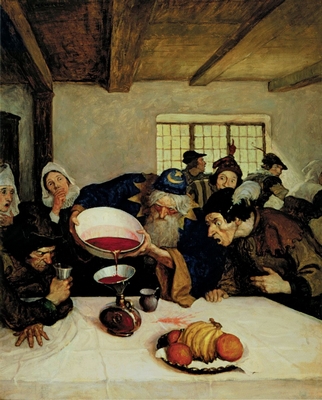
Why This Map is Invaluable, What is Your Name, My Boy?, 1907
Oil on canvas
Bank of America Collection


N.C. Wyeth
N.C. WYETHS (American, 1882 - 1945)
The Astrologer Emptied the Whole of the Bowl, 1916
Oil on canvas
Bank of America Collection

Drawing from the Bank of America Collection, this exhibition provides a revealing survey of works by N.C. Wyeth, one of America’s finest illustrators; his son Andrew, an important realist painter; Andrew’s son Jamie, a popular portraitist; and members of the extended family. Visitors can explore 74 paintings and drawings by artists from three generations of the Wyeth family, all showcasing a commitment to realism, technical brilliance, and narrative sensibility.


N.C. Wyeth
N.C. WYETHS (American, 1882 - 1945)
Cover Illustration for Rip Van Winkle, 1921
Oil on canvas
Bank of America Collection


N.C. Wyeth
N.C. WYETHS (American, 1882 - 1945)
Gnomes Bowling, 1921
Oil on canvas
Bank of America Collection

N.C. WYETHS (American, 1882–1945) has long been considered one of the nation’s leading illustrators, a versatile artist who was able to traverse fantasy and realism. In the early 1900s, he studied with illustrator Howard Pyle in Delaware. In 1911, he built a house and studio in nearby Chadds Ford, Pennsylvania. Later, he bought a sea captain’s house in Maine and in 1931 built a small studio, which he shared with his son Andrew and his daughters. The exhibition includes illustrations for books by Robert Louis Stevenson and Washington Irving as well as historical scenes, seascapes and landscapes that illuminate N.C. Wyeth’s work.


N.C. Wyeth
N.C. WYETHS (American, 1882 - 1945)
On the Sea Wall With John Paul Jones, 1928
Oil on canvas
Bank of America Collection


N.C. Wyeth
N.C. WYETHS (American, 1882 - 1945)
Eight Bells, 1937
Oil on hardboard
Bank of America Collection


N.C. Wyeth
N.C. WYETHS (American, 1882 - 1945)
Marines Landing on the Beach, 1944
Oil on hardboard
Bank of America Collection

Born 100 years ago, ANDREW WYETHS (American, 1917–2009) is one of the United States’ most popular artists, known for his haunting, detailed paintings in the American Realist tradition. He was influenced by the works of Winslow Homer, whose watercolor technique he admired, as well as by the art of Howard Pyle and his father N.C. While Andrew painted recognizable images, his use of line and space often imbue his works with an underlying abstract quality. The exhibition includes important works from across his career.

Although not as well-known as her brother, HENRIETTE WYETHS (American, 1907-1997) painted striking portraits, landscapes, and still lifes. She is also represented in the exhibition, as is her husband, PETER HURD (American, 1904-1984), who chronicled the landscape of the American West.

JAMIE WYETHS (American, b. 1946), like his father and grandfather, paints subjects of everyday life, turning his wry, playful eye to the landscape, animals and people of Pennsylvania and Maine. In contrast to his father—who painted with watercolor, drybrush and tempera—Jamie works in oil and mixed media, creating lush painterly surfaces. The 17 paintings in the exhibition represent all periods of his career.

“We’re excited for our community to see the evolving legacy of one of America’s most illustrious artistic families,” said Brian Ferriso, The Marilyn H. and Dr. Robert B. Pamplin, Jr. Director and Chief Curator of the Portland Art Museum. “As the Museum approaches its 125th anniversary this fall, it’s clear that a big part of our mission is to celebrate, support, and spark the spirit of creative inquiry that the Wyeths represent, from one generation to the next. We are grateful to Bank of America for its generosity in lending this collection.”

Curator: Brian J. Ferriso, The Marilyn H. and Dr. Robert B. Pamplin Jr. Director and Chief Curator.

PORTLAND ART MUSEUM
1219 W Park Avenue, Portland, Oregon 97205
www.portlandartmuseum.org

30/08/12

Illustrator : les nouveautés disponibles en avant première pour les abonnés à Adobe Creative cloud

Illustrator, le logiciel professionnel de graphisme d'Adobe fait l'objet d'améliorations dont peuvent profiter pour l'instant, en avant-première, les seuls abonnés à Adobe Creative Cloud. Les nouveautés doivent offrir des gains de temps aux créatifs et graphistes et faciliter la remise de fichiers à des collègues, clients et prestataires.


Parmi les nouveautés de cette version d’Adobe Illustrator figurent : 

– L’assemblage de fichiers permet aux créatifs de rassembler automatiquement tous les fichiers utilisés dans un projet Illustrator, notamment les images liées et les polices, dans un seul et même dossier, rendant ainsi les transferts et le partage de projets plus efficaces et sans erreurs. 

– L’exportation en fichiers autonomes des images incorporées permet aux graphistes d’exporter en fichiers autonomes les images incorporées, dans un fichier Illustrator, par d’autres créatifs ou clients, permettant ainsi de gagner du temps.

– L'amélioration du panneau Liens permet aux utilisateurs de voir et de suivre plus rapidement les informations concernant une illustration importée dans un fichier Illustrator. Toutes les opérations indispensables pour s’assurer que les images importées remplissent les critères pour l’impression sont maintenant regroupées dans une seule fenêtre. 

D'autres nouveautés vont être disponibles dans peu de temps. En septembre l’édition Single de Digital Publishing Suite sera intégrée au Creative Cloud, pour la publication de brochures, de portfolios et d’ouvrages illustrés sous forme d’applications sur l’iPad. Les abonnés au Creative Cloud bénéficieront, également en exclusivité, de nouvelles fonctionnalités d’Adobe Dreamweaver. Adobe prévoit d’autres innovations à destination des abonnés au Creative Cloud dans les prochains mois. 

Creative Cloud est proposé sur abonnement aux particuliers dans 36 pays at dns plusieurs langues. La formule annuelle coûte 50 € HT par mois et la formule mensuelle 75 € HT par mois. Les clients possédant une licence individuelle d’une édition Creative Suite ou d’un produit seul, en version CS3 ou ultérieure, ont droit à un tarif d’abonnement préférentiel en formule annuelle à 30 € HT par mois la première année. Un tarif Education est également disponible. Pour en savoir plus, consultez la page dédiée au Creative Cloud sur le site d'Adobe :

14/10/98

Aubrey Beardsley Centennial Exhibition, Princeton University Library

Aubrey Beardsley Centennial Exhibition
Princeton University Library
Through January 7, 1999

The Princeton University Library is currently commemorating the 100th anniversary of the death of the Aubrey Vincent Beardsley (1872-1898), the celebrated English artist and book illustrator, with an exhibition in the Leonard L. Milberg Gallery for the Graphic Arts, Harvey S. Firestone Memorial Library.

The exhibition draws on the Department of Rare Books and Special Collections’ unrivaled Beardsley holdings, including original drawings, posters, photographs, correspondence, literary manuscripts, illustrated books, memorabilia, and other materials. Most of these materials were donated to the Princeton University Library a half-century ago by A.E. (Albert Eugene) Gallatin (1881-1952), the American artist, art critic, art historian, and collector. Gallatin’s gift was supplemented by materials from the J. Harlin O’Connell Collection of the 1890s and by other gifts. With 125 original drawings, Princeton can boast the finest Beardsley collection in the world.

Aubrey Beardsley’s brilliant but controversial work was emblematic of the English fin-de-siecle. This most literary of artists was much influenced by the pre-Raphaelites, Japanese woodblock printmakers, and contemporary French writers. But he was more than the sum of influences, developing a unique artistic vision that was bold and original despite its eclecticism. Through his drawings and writings, he became the leading exponent of a British movement referred to by its detractors as "decadent," much as was Oscar Wilde in literature. 

While Aubrey Beardsley only lived to age 25 and is closely associated with the 1890s, he had a profound influence on visual arts and book illustration for decades. Among the nearly 100 items on exhibit are original drawings, first editions, and other materials pertaining to Beardsley’s contributions to Sir Thomas Mallory’s Le Morte Darthur (1893-94), Oscar Wilde’s Salome (1894), The Yellow Book (1894-95), The Savoy (1896-97), and The Lysistrata of Aristophanes (1896) and other illustrations published by Leonard Smithers. Also included are portraits of Aubrey Beardsley by such contemporary artists as Sir William Rothenstein and Max Beerbohm.

The exhibition is curated by Mark Samuels Lasner, author of Selective Checklist of the Published Work of Aubrey Beardsley (1995); and Don C. Skemer, Curator of Manuscripts.

PRINCETON UNIVERSITY