Showing posts with label Alberto Giacometti. Show all posts

03/08/25

Giacometti / Marwan Obsessions Exhibition @ Institut Giacometti, Paris

GIACOMETTI / MARWAN OBSESSIONS
Institut Giacometti, Paris
21 October 2025 - 21 January 2026

In the coming autumn, Institut Giacometti in Paris will present the exhibition GIACOMETTI / MARWAN OBSESSIONS, an original encounter between two artists who, having chosen to work in a country different from their birth country - France and Germany respectively - questioned the issues around modernity from two different cultural spaces: Europe and the Middle-East. Alberto Giacometti and MARWAN turned the representation of the head into the core of an enduring research that established their position as artists. This exhibition, the first joint presentation of their works, proposes a trail in which surrealism and MARWAN’s first works (1962-1972), drawings, large heads and sculpted portraits, echo one another, asserting a strong connection between visual art research and reflection on the human. 

Marwan Kassab-Bachi, called MARWAN, was born in Damascus in 1934. After having studied Arabic literature at the University of Damascus, determined to embrace an artistic career, politically committed and highly conscious of the mutations taking place in his country following colonialism, he settled in 1957 in Berlin, the epicentre of the Cold War. Like Georg Baselitz and Eugen Schönebeck, also students at the Hochschule für Bildende Kunst in Berlin, he chose figuration, breaking from the informal art dominating West-Germany at the time. For him, it was not a position from which to confront the traumas of recent European history but a theatre for the intimate.

In the 1950s and 1960s, Giacometti also resisted the attraction of informal abstraction, reiterating his commitment to figuration and the representation of the human. From 1919, and even more from 1935, when he returned to working with a model, it was on heads that were focused his questioning on the perception of reality.

From 1985 to his death in 2016, MARWAN took Heads as his sole subject. Before that, after he arrived in Berlin in 1957, his first works (1962-1972) were portraits and intimate scenes, whose framing and execution express the challenges of being alive that echo Giacometti’s works like Mother and daughter, The Cage and Walking Woman from 1932.

From 1964 and 1972, MARWAN’s first works were focused on figures with deformed bodies, “portraits” of icons of Arab modernity: the Iraqi poet Bader Chaker al Sayyab, the political thinker Munif al-Razzaz, both exiled from their country, persecuted for their ideas. All seem to be suffused with a strange melancholy.

His year as artist in residence at la Cité internationale des arts in Paris in 1973, marked a break. He began a new series of large format paintings in which heads, painted in broad sinuous touches size up the visitors.

MARWAN linked those Heads-landscapes to the outlines and colours of the Syrian countryside. With the still life and puppets coming after, he continued to experiment with colour while placing the human at distance. From 1983, he went back to tall Heads, endowed with a cosmic character, covering the totality of the support, a series uninterrupted till his death.

MARWAN worked little with models, and his huge Heads have the quality of apparitions. They are strangely close to Giacometti’s post-war plasters and bronzes, remarkable for their spiky matter. Like those, the Heads emerge from a profusion of touches, marks that create their own space and in which only the eyes and a wide red mouth, like a horizontal stroke, arise. Clay, plaster, drawings, paintings, all the mediums Giacometti used embody his intense and involved attention to the model. From the study of his close relatives, his wife Annette and his brother Diego, to the large heads in plaster from the beginning of the 1960s, Giacometti kept, even in his work from memory, the reminiscence of the face-to-face with the model. In this observation, there’s no realist purpose, but the manifestation of a gesture repeated, at times erased and absolutely necessary that grounds the existence of the artist as a human being. Here too Giacometti and MARWAN connect.

Curator: Françoise Cohen

Giacometti / Marwan. Obsessions - Catalogue
GIACOMETTI / MARWAN. OBSESSIONS - The catalogue
Catalogue under the direction of Françoise Cohen, exhibition curator
Co-edited by Fondation Giacometti, Paris / Fage éditions, Lyon
Bilingual French / English, 122 pages, 16.5 x 2.5 cm
Texts by Françoise Cohen and Rasha Salti
A not previously published interview of MARWAN by Hans Ulrich Obrist
Unpublished extracts of the artist’s journal

INSTITUT GIACOMETTI
5 rue Victor-Schoelcher, 75014 Paris

09/04/25

TETAF NY 2025 - First Look - Artworks, Artists, Galleries

TETAF NEW YORK 2025
Park Avenue Armory, NYC
MAY 9 — 13, 2025

TETAF New York 2025
COURTESY OF TETAF
The European Fine Art Foundation - TEFAF - unveiled a preview of select works that will be featured at TEFAF New York 2025, taking place from May 9 – 13 (May 8 VIP day by invitation only). This "First Look" offers a glimpse of the exceptional range and caliber of artworks to be showcased at the Park Avenue Armory this year.

At TETAF New York 2025, 91 of the finest dealers and galleries from 13 countries and 4 continents will bring the best in Modern and Contemporary Art, Jewelry, Antiquities and Design to the vibrant art community of New York City. Besides the exhibitor stands in the Wade Thompson Drill Hall, TEFAF New York 2025 will also showcase exclusive curated spaces in the Armory's 16 period rooms. 

EMMA REYES 
PRESENTED BY LEON TOVAR GALLERY 
(STAND 366)

Emma Reyes
EMMA REYES
White Poppy, 1979
Work on paper
41 x 28 inches (104.14 x 71.12 cm)
PHOTO COURTESY OF LEON TOVAR GALLERY
White Poppy (1979) by Emma Reyes, depicts a fully bloomed white poppy alongside five buds in the shadows. This piece exemplifies Reyes’ signature style of vibrant compositions and close-up floral portrayals, which transform flowers into living beings, almost like portraits. Her work often seeks to restore humanity’s connection with nature, a theme central to White Poppy. The white poppy symbolizes a commitment to peace, an everpresent motif in Reyes' oeuvre.

ALBERTO GIACOMETTI 
PRESENTED BY GALERIE MARCILHAC 
(STAND 340)

Alberto Giacometti
ALBERTO GIACOMETTI
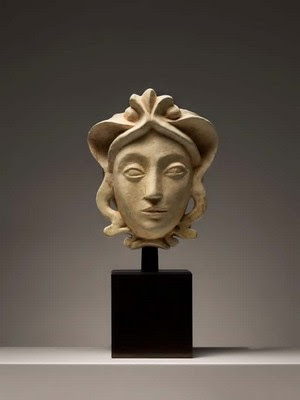
Masque coiffure, c. 1933
Plaster sculpture with gilding traces
9.4 x 6.1 x 6.4 inches (24 x 15.5 x 16.5 cm)
PHOTO CECIL MATHIEU
COURTESY OF GALERIE MARCILHAC
Alberto Giacometti is considered one of the most famous figures of the French avant-garde of the 20th century. Giacometti, a genius sculptor, also showed his talent in the field of decorative arts as he modeled little objects of various shapes early on. Jean-Michel Frank was the first to detect the innovation potential of such an aesthetic applied to movable creations; in 1928, he commissioned his first objects to the sculptor.

This piece, a "Mask" or "Hairdressing mask" plaster sculpture with gilding traces, was designed by Alberto Giacometti in 1933 for Frank. The pieces for Frank reveal a mastering of the space and a stylistic purification – whether it manifest itself through geometrical of figurative shapes, which were rarely reached by the contemporaries of the artist; they can be lightened to real independent works of art, more than simple daily objects.
 
MANTUA NANGALA 
PRESENTED BY SALON 94 
(STAND 320)

Mantua Nangala
MANTUA NANGALA
Untitled, 2024
Acrylic on linen
96 x 72 inches (243.84 x 182.88 cm)
PHOTO COURTESY OF SALON 94
Mantua Nangala's Untitled (2024) visualizes her ancestral homeland in the Gibson Desert of Western Australia through intricate dots in varying shades of cream and white. This work embodies the stories passed down through generations of her family, particularly the Kanaputa women's creation narratives that shaped this desert landscape. Nangala’s painting transforms these inherited stories into rhythmic patterns that map both physical and spiritual geography. Mantua Nangala has long been associated with Papunya Tula, an arts collective that has helped revolutionize contemporary Aboriginal art. By adopting acrylic paints and canvas, they have moved their artists' traditions into the future while preserving their cultural legacy.


LINE VAUTRIN
PRESENTED BY GALERIE CHASTEL-MARÉCHAL 
(STAND 318)

Line Vautrin
LINE VAUTRIN
Mirror, c. 1960
Mirror and talosel
10.6 inches (27 cm)
PHOTO BY MARINA GUSINA
Born in Paris in 1913, Line Vautrin was an artist, designer and creator of jewelry and decorative objects. A unique and fiercely independent artist, she worked in post-war Paris to create pieces renowned for their intensity and poetry.

The round structure, embossed with honeycomb motifs, alternates openwork parts encircled with blue talosel and gilded mirror cabochons. The inner part features a crown of inlaid oval gilded and parma mirrors. The back of the mirror is dotted and presents the two talosel colors.

MARIE LAURENCIN
PRESENTED BY ALMINE RECH 
(STAND 322)

Marie Laurencin
MARIE LAURENCIN
Jeune Fille au bouquet, c. 1935
Oil on canvas
Unframed: 18.13 x 14.75 inches (45.9 x 37.5 cm)
Framed: 30.75 x 27.63 x 3.38 inches (78.1 x 70.2 x 8.6 cm)
© THE ESTATE OF MARIE LAURENCIN 
COURTESY OF THE ESTATE AND ALMINE RECH
PHOTO: DAN BRADICA
Marie Laurencin was never one to shy away from the title of "woman artist," embracing all things girlish with little hesitation or apology. Throughout her long and storied career, she not only elevated female sitters—rarely choosing to represent men—but also cultivated a deliberately dainty aesthetic. She favored pastel tones, naïve storybook figuration, and airy brushstrokes. Her pretty pictures of pretty girls were more than just an ode to the power and allure of the feminine. They also functioned as visual expressions of Laurencin’s fluid sexual identity, which caused her pursue love affairs with both men and women. As a recent retrospective at the Barnes Foundation contended, the artist possessed a singular queer aesthetic that "subtly but radically challenges existing narratives of modern European art."
 
PARK SEO-BO
PRESENTED BY TINA KIM GALLERY 
(STAND 358)

Park Seo-Bo
PARK SEO-BO
Ecriture No. 31-75, 1975
Pencil and oil on canvas
51.13 x 76.13 inches (129.87 x 193.37 cm)
PHOTO COURTESY OF THE PARKSEOBO FOUNDATION
This work belongs to Park Seo-Bo’s hallmark Ecriture series, which he first began developing in 1967. Ecriture began as a series of monochromes in which Park covered his canvas with a single color and then manipulated the still-wet surface with repetitive carving gestures—actions that resemble the writing of a script and draw from Eastern calligraphic traditions. In this earlier phase of the series, he used a pencil to create these repetitive marks, imbuing the canvas with intricate, rhythmic lines that evoke both the texture of handwriting and the process of meticulous craftsmanship. In the mid-1980s, he introduced hanji paper into the series, layering and scraping the pulp on the wet surface to create a new sequence of sculptural lines that seem to float above the canvas.

GURO MASK
PRESENTED BY GALERIE LUCAS RATTON 
(STAND 351)

Guro Mask
Guro Mask
1929
Wood and pigments
12.38 inches (31.5 cm)
PHOTO BY VINCENT GIRIER DUFOURNIER 
COURTESY OF GALERIE LUCAS RATTON 
This Guru mask from Côte d’Ivoire comes from the former collection of the renowned painter Maurice de Vlaminck (1876-1958). Used in the "Gu" cult, it represents a protective female figure, whose elevated status is expressed through the finesse and power of its features. The elongated shape of the face is sculpted with great precision, emphasizing the elegant curve of the prominent forehead, which subtly extends to the tip of the nose, perfectly balanced by the groove of the mouth. The slit eyes are topped with a pronounced brow ridge, enhancing the mask’s mysterious and charismatic expression. Every detail of this face, carved with remarkable delicacy, evokes both harmony and grace. The meticulous attention given to the representation of the female figure, combined with the incomparable patina, grants this masterpiece a sense of balance, delicacy, and majesty.

ROBERT COTTINGHAM
PRESENTED BY 
GALERIE GEORGES-PHILIPPE & NATHALIE VALLOIS 
(STAND 363)

Robert Cottingham
ROBERT COTTINGHAM
Meat Counter, 1966
Oil on canvas
40 x 60 inches (101.5 x 152.5 cm)
PHOTO COURTESY OF GALERIE GP & N VALLOIS
Meat Counter is one of Robert Cottingham's earliest paintings, and an extremely rare example of his work from the 1960s. It reveals the influence of his original career in advertising while also showcasing the early signs of his skill as a photorealist. Cottingham's attention to detail draws him towards reflections or marbling while keeping the painterly aspect of brushstrokes and swathes of color.

GUIDETTE CARBONELL
PRESENTED BY LEBRETON GALLERY 
(STAND 315)

Guidette Carbonell
GUIDETTE CARBONELL
Cocotte qui Freine, c. 1949
Ceramic, wrought iron
21 x 11 x 19 inches (53.34 x 27.94 x 48.26 cm)
PHOTO COURTESY OF LEBRETON GALLERY
Born in 1910 to a Catalan father and an Armenian-born mother who was a painter, Guidette Carbonell attended several painting workshops, before dedicating herself fully to ceramics. She made her debut at the Salon d'Automne in 1928. With her white enamels speckled with bright colors, she decidedly distanced herself from the austere and meticulous approaches of her predecessors. Close to the abstract painters of the School of Paris, she sought to simplify her forms, notably through a series of stylized luminous birds that she presented at the Jeanne Bûcher Gallery in 1949. She also explored materials by combining earth with pebbles or shards of glass to create decorative plates inspired by the imagination of Bernard Palissy.

JEAN PROUVÉ
PRESENTED BY GALERIE PATRICK SEGUIN 
(STAND 331)

Jean Prouve
JEAN PROUVÉ
Croismare school, 1948
Steel, wood and glass
1259.88 x 315 inches (32 x 8 m)
PHOTO COURTESY OF GALERIE PATRICK SEGUIN
The size of the building, the quality of its architectural treatment and the skills of the Atelier Jean Prouvé captured visitors’ attention as soon as it opened. The 255m² (2.744 sq ft) construction numbers seven central portal frames, over 9 feet high, and two external walkways that derive their elegance from the slenderness of the tubular portal frames. The facade panels, solid or glazed, give rhythm and contrast.

The monumental entrance canopy in folded sheet steel is an autonomous module supported by two struts, key elements in Jean Prouvé’s work. Two axial portal frames and the ridge beam of the Croismare school will be specially reassembled for TEFAF New York 2025. A model will also be presented, illustrating the scale of this demountable architecture, the largest ever designed by Jean Prouvé.

THE BLANCHARD OSIRIS
PRESENTED BY DAVID AARON LTD 
(STAND 212)

Osiris
The Blanchard Osiris
Circa 664-332 B.C.
Bronze
21.7 inches (55 cm)
PHOTO COURTESY OF DAVID AARON LTD
A bronze statuette of mummiform Osiris on a wooden base. The god wears the White Crown of Upper Egypt, with a central uraeus and chin strap, which would have originally attached to a false beard (now missing). The facial features are cast in fine detail, with slender eyebrows over recessed almond-shaped eyes with prominent cosmetic lines. The hands are crossed over the chest, and the lower ends of the crook and flail remain below the fists – originally these implements would have extended upwards towards the shoulders. Statuettes such as this were made in a range of sizes, and this is a notably large example. One of similar size is now in The Metropolitan Museum, New York (61.45).

HEMMERLE MUNICH
PRESENTED BY HEMMERLE 
(STAND 339)

Hemmerle Munich
HEMMERLE MUNICH
Hemmerle bangle, 2025
Spessartine garnets, knitted almandine, 
stainless steel, bronze, white gold
1.65 inches (42 mm) diameter
PHOTO COURTESY OF HEMMERLE
A unique creation showcasing artistry and innovation, this Hemmerle bangle seamlessly weaves history and craftsmanship into an exquisite contemporary jewel. Crafted using a revived 19th-century Austrian knitting technique, delicate almandine garnet beads are meticulously handknitted with silk threads to form an intricate, flexible structure that embraces the wrist with effortless elegance. The ends of the bangle are adorned with spessartine garnets, set in a striking combination of bronze and white gold on the reverse, creating a warm, harmonious tonality that highlights Hemmerle’s signature fusion materials. This one-of-a-kind creation is a testament to Hemmerle’s dedication to reviving historical techniques while pushing the boundaries of contemporary jewelry design.

ALEXANDER CALDER
PRESENTED BY GALERIE MIGNONI 
(STAND 302)

Alexander Calder
ALEXANDER CALDER
Voiles, 1973
Work on paper
30.69 x 22.44 inches (78 x 57 cm)
PHOTO COURTESY OF GALERIE MIGNONI

Alexander Calder initially began his artistic journey as a painter but didn’t explore gouache as a medium until a yearlong stay in Aix-en-Provence, France, in 1953, when he was in his mid-sixties. From that point forward, he continued to create works on paper alongside his sculptural practice. This more immediate medium allowed Calder to effortlessly translate the bold, vivid language of his sculptures into two dimensions. Working with speed and spontaneity, he employed dynamic lines and planes of his signature primary colors to convey geometric patterns, natural motifs, and metaphysical themes that inspired him.

ANNE IMHOF
PRESENTED BY SPRÜTH MAGERS 
(STAND 306)

Anne Imhof
ANNE IMHOF
Untitled (Silas), 2024
Bronze cast
50.88 x 46 x 9.63 inches (129 x 117 x 24.3 cm)
Edition of 3 + 1 AP
© ANNE IMHOF, KUNSTHAUS BREGENZ
COURTESY OF THE ARTIST AND SPRÜTH MAGERS
PHOTO: MARKUS TRETTER
Imhof ’s most recent works transform ongoing drawing practice into sculptural, patinated bronze reliefs in the tradition of artists from antiquity to the Italian Renaissance through August Rodin. In Untitled (Silas) (2024), Imhof ’s lines and shading are translated into three dimensions, the figures becoming literally embodied, with seductively smooth, bronzed skin. The scene depicts androgynous characters with limbs entwined, flanked by a dog and dolphins. This peaceful view is counteracted by the image of a mushroom cloud bursting on the horizon, which renders the protective embrace of the humans and animals especially poignant and mysterious. Expanding on themes of melancholy and allegory present throughout Imhof ’s oeuvre, the works on view at TEFAF New York 2025 exhibit the artist’s compelling synthesis of symbolic figural representations, imagined narratives, art and cultural history.

LOUIS COMFORT TIFFANY
PRESENTED BY DELORENZO GALLERY 
(STAND 354)

Louis Comfort Tiffany
LOUIS COMFORT TIFFANY
Tiffany Studios Wisteria Table Lamp, 1905
Leaded stained glass shade on a bronze base
Height: 27 inches (68.6 cm) Shade : 18 inches (45.7 cm)
PHOTO BY CHRISTIES
The Wisteria lamp was the first Tiffany lamp to feature an irregular bottom border. Each piece of glass is individually selected and cut, with over two thousand pieces required to create a single lamp. Considered a luxury item, Tiffany Wisteria lamps have always commanded some of the highest prices, both historically and today.

Its tree-like base was inspired by the Bella Sombra trees of Gibraltar. During a company retreat to Gibraltar, Tiffany and his collaborators—lamp designers Clara Driscoll and Agnes Northrup—were drawn to the tree’s strength and functionality.

The Wisteria lamp has been exhibited in major museums, including the Metropolitan Museum of Art, the Virginia Museum of Fine Arts, and the New-York Historical Society.

ZAHA HADID
PRESENTED BY DAVID GILL GALLERY 
(STAND 204)

Zaha Hadid
ZAHA HADID
Coffee Table Liquid Glacial, 2012
Color acrylic
15.7 x 106.3 x 35.4 inches (40 x 270 x 90 cm)
PHOTO COURTESY OF DAVID GILL GALLERY
Zaha Hadid’s coffee table Liquid Glacial, with its subtle rippling surface, recalls the motion of water captured in glistening acrylic. It embodies the soft transition of forms that is signature to Hadid’s architecture. The collection embraces cutting-edge 3D technology to defy its materiality and create works that remain atemporal. Since their debut collaboration with the Dune formations at the Venice Biennale in 2007, Hadid and Gill have strived to create furniture collections that push the boundaries of contemporary design, debuting Liquid Glacial in 2012 and Stellarluna and Ultrastellar in 2016, shortly before the architect’s passing.

TAHER ASAD-BAKHTIARI
PRESENTED BY HOSTLER BURROWS 
(STAND 203)

Taher Assad-Bakhtiriari
TAHER ASAD-BAKHTIARI
Tribal Weave, 2024
Gabbeh woven wool with exposed warp
118 x 98.5 inches (299.72 x 250.19 cm)
PHOTO COURTESY OF THE ARTIST AND HOSTLER BURROWS
Taher Asad-Bakhtiari (b. 1982, Tehran, Iran) offers a striking, contemporary take on hand-woven textiles and furnishings, mapping out a bold style of open-work tapestries which retool the kilim flatweaves and denselyknotted gabbeh rugs that have long defined his region’s cultural traditions. Asad-Bakhtiari’s fabric constructions feature large-scale triangular patterns, intersected by striated bars and lines. These minimalist forms override the logic of warp and weft, evoking landforms and the iconography of ancient civilizations. They also reference the repeated geometries of mid-century avant-garde design and the craft movement, such as those seen at Black Mountain College. Woven from hand-spun and naturally-dyed wool with the occasional inclusion of contemporary materials, these lace-like works seek to spur new creative wrinkles within a craft tradition dating back centuries.

WALDEMAR CORDEIRO
PRESENTED BY THE MAYOR GALLERY 
(STAND 310)

Waldemar Cordeiro
WALDEMAR CORDEIRO
Untitled, 1952
Enamel on plywood
9.25 x 12 inches (23.5 x 30.5 cm)
PHOTO COURTESY OF ESTATE OF THE ARTIST, 
THE MAYOR GALLERY AND LUCIANO BRITO
Waldemar Cordeiro, one of Brazil's greatest concrete art exponents of the 1950s, was a visionary artist and theorist, merging theory and practice in an impressive body of work. His significance is increasingly recognized globally, featured at the 2024 Venice Biennale, his centenary is being celebrated at the ZKM Karlsruhe, Germany in a retrospective. Born in 1925 in Rome, Waldemar Cordeiro moved to São Paulo after WWII and co-founded the "Ruptura" movement in 1952, challenging figuration in art. His works, including Untitled (1952), showcase a blend of sensory interplay and technological distancing. Later, Waldemar Cordeiro pioneered computer-based art, with notable pieces like The Woman Who is not B.B. (1971).

JOSEF FRANK
PRESENTED BY MODERNITY STOCKHOLM 
(STAND 370)

Josef Frank
JOSEF FRANK
Chest of drawers 'Flora,' model 1050, 1960
Mahogany, hand printed paper 'Nordens flora' 
by C.A. Lindman & brass handles.
29.9 x 52.36 x 17.3 inches (76 x 133 x 44 cm)
PHOTO COURTESY OF MODERNITY

This sophisticated chest of drawers, titled the 'Flora,' model 1050, is a classic creation by the celebrated Josef Frank for Svenskt Tenn in the 1930s. Renowned as one of Sweden's most influential designers, Josef Frank masterfully combined functionality with artistic design in this timeless piece. Crafted from premium mahogany, the chest is adorned with hand-printed paper from 'Nordens flora' by C.A. Lindman and complemented by elegant brass handles. The intricate botanical motifs honor the harmony between nature and design, creating a visually stunning and meaningful aesthetic.

ROMAN HEAD OF A BEARDED GOD
PRESENTED BY CHARLES EDE 
(STAND 356)

Roman head of a bearded god
c. 2nd century AD
Marble
7.9 inches (20 cm)
PHOTO COURTESY OF CHARLES EDE / JARON JAMES
This sculpture captures the head of a bearded male, possibly Zeus or Poseidon, but most likely Asclepius, god of medicine, carved from marble with added use of a hand drill. His luxuriant mane of hair is arranged in thick, flame-like locks which sweep upwards and off his forehead in layers from a centre parting, and fall around his face in voluted waves. His heavily lidded eyes gaze straight forwards and have incised irises and drilled crescentic pupils. There is a deep crease on his forehead, his nose is straight, and his full, slightly parted lips, are framed by a centrally divided beard of overlapping curls. Broken diagonally across the face with some restoration to the lips, the upper right side of the anastole-like hair restored.
 
LUCIO FONTANA
PRESENTED BY TORNABUONI ART 
(STAND 353

Lucio Fontana
LUCIO FONTANA
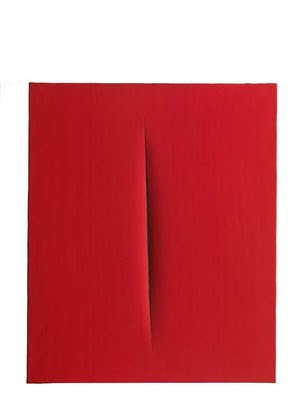
Concetto spaziale, Attesa, 1965
Water-based paint on canvas
25.9 x 20.9 inches (66 x 53 cm)
PHOTO COURTESY OF TORNABUONI ART
Lucio Fontana combined the highly saturated monochromatic purity of Klein’s canvases with Pollock’s violently physical action. Fontana’s gesture annihilated Pollock's proclivity toward additive mark-making and replaced it with a vandalistic destructiveness. Drawing attention to the materiality of the picture-plane, Fontana’s cuts question classical interpretations of a ‘figure-ground’ relationship; rather than striving toward an illusion of perspectival depth, Fontana’s punctures create forms within the canvas that embody a real third dimension of space. Moreover, the painting’s chromatic radiance amplifies the profound darkness of the plunging black recesses that aptly signify Fontana’s quest for ''the Infinite, the inconceivable chaos, the end of figuration, nothingness.'' (Lucio Fontana cited in Lucio Fontana, exhibition catalogue, London 1999).

SHIRLEY JAFFE
PRESENTED BY GALERIE NATHALIE OBADIA 
(STAND 364)

Shirley Jaffe
SHIRLEY JAFFE
Untitled, c. 1967
Oil on canvas
51.13 x 34.63 inches (130 x 88 cm)
PHOTO © GALERIE NATHALIE OBADIA
Based on the idea of a movement as the starting point, Jaffe assembles signs within the frame of the canvas, tempering their individual energies and adjusting her palette in order to achieve the overall formal and sensorial equilibrium of the composition. Never overloading the canvas with material so as not to muddy its communication with the viewer, Shirley Jaffe makes works that are states of play, freeze-frames of a flux, immortalizing fugacity, the frantic effervescence of mixed urban forms, isolating and adjusting them precisely on the canvas. The effect of disorientation is pronounced, yet the paintings continue to find their balance in this imbalance. The language of Jaffe’s architectures truly becomes the expression of a shared visual memory.

DANIEL RICHTER
PRESENTED BY GALERIE THADDAEUS ROPAC 
(STAND 345)
At TETAF New York 2025 Galerie Thaddaeus Ropac will present a painting by Daniel Richter titled Triumpf des Höhnischen, 1924 (Oil on canvas, 91.73 x 68.11 x 2.55 inches / 233 x 173 x 6.5 cm).
Daniel Richter’s most recent series of paintings shows anthropomorphic creatures against chromatic backgrounds. Rendered in a spectrum of bright, prismatic colors, the works oscillate between geometric rigidity and organic fluidity. The German artist first came to prominence in the 1990s when he transitioned into fine art from the world of music, where he began his career designing posters and record sleeves for punk bands. Daniel Richter combines motifs from art history, mass media and pop culture to create idiosyncratic, surreal worlds. Ever the innovator, his recent paintings tread a path between figuration and abstraction, typified by the chaotic entanglements of fragmented bodies. Evoking a sense of rebellious energy and electric vibrancy, making the figures both playful and defiant.
 
TETAF NEW YORK 2025

17/03/25

Alberto Giacometti / Petrit Halilaj @ Institut Giacometti, Paris - Exposition « Nous construisions un fantastique palais la nuit... »

Alberto Giacometti / Petrit Halilaj
« Nous construisions un fantastique palais la nuit... »
Institut Giacometti, Paris
14 mars - 8 juin 2025

L’exposition « Nous construisions un fantastique palais la nuit... », présentée à l’Institut Giacometti, met en dialogue les œuvres et installations originales du plasticien contemporain Petrit Halilaj et un choix d’oeuvres d’Alberto Giacometti. Marqué par son enfance dans un Kosovo en guerre, Petrit Halilaj développe une pratique où les histoires individuelles et collectives se nouent dans des espaces de liberté, non dénués de jeu et de légèreté. Le dessin d’enfant nourrit son travail dans lequel il ouvre un horizon onirique, voire magique, à la sculpture ; un espace onirique qui fait écho à la part de l’enfance souvent discernable dans l’oeuvre de Giacometti. 

Prenant appui sur une pensée de Giacometti à partir de son oeuvre Le Palais à 4h du matin (1932), le titre et les oeuvres de l’exposition explorent la force des constructions fantasmatiques et fragiles que sont les oeuvres des artistes. Dans une installation originale pensée par Petrit Halilaj, l’exposition tisse un réseau subtil de lignes entre les oeuvres de Giacometti. Rêves, espoirs, mais aussi craintes et peurs s’y lient dans des structures fragiles qui emportent et témoignent d’une capacité à communiquer de puissants imaginaires. Face au sentiment d’un monde précaire, les oeuvres d’Halilaj et de Giacometti mobilisent une capacité salvatrice d’invention.

En près d’une trentaine d’oeuvres produites spécifiquement pour l’exposition, Petrit Halilaj explore dans le vocabulaire enfantin de ses « Abetare » une forme de dessin dans l’espace qui est devenu un moyen d’expression propre. L’exposition, nourrie du rapport intense d’Halilaj au dessin d’enfant comme témoignage du monde contemporain, révèle de manière inédite un intérêt et un usage proche chez Alberto Giacometti, déployant les thèmes riches de l’enfance, du rêve, des associations d’idées, du rapport à la merveille.

Un catalogue sous la direction d’Hugo Daniel, richement illustré, en édition bilingue français / anglais, coédité par la Fondation Giacometti, Paris, et FAGE éditions, Lyon, accompagne l’exposition.

PETRIT HALILAJ

Né en 1986 à Kostërrc, Kosovo, Petrit Halilaj vit et travaille entre l’Allemagne, le Kosovo, l’Italie et la France. Il a étudié à l’Académie des beaux-arts de Brera à Milan. Il est actuellement professeur à l’École nationale supérieure des beaux-arts de Paris, en France, avec son partenaire et collaborateur artistique, Álvaro Urbano. Il est membre de l’Akademie der Künste der Welt.

Petrit Halilaj a représenté le Kosovo dans son premier pavillon national à la 55e  Biennale de Venise en 2013. En 2021, la Tate St Ives a présenté son exposition personnelle «Very volcanic over this green feather». En 2024, Petrit Halilaj a ouvert une installation in situ dans le cadre de la commission pour le jardin sur le toit du Met, New York. En 2025, Petrit Halilaj présentera une exposition personnelle au Hamburger Bahnhof, à Berlin. Petrit Halilaj a présenté des expositions individuelles au Musée Tamayo au Mexico, au Musée de la Croix et du Croissant-Rouge, Genève ; au Fries Museum, Leeuwarden, Pays-Bas ; à la Tate St Ives, UK ; au Palacio de Cristal, Museo Reina Sofía, Madrid ; au New Museum, New York ; à la Fondazione Merz, Turin, Italie ; au Hammer Museum, Los Angeles, USA ; au Paul Klee Zentrum, Berne ; au Pirelli HangarBicocca, Milan, Italie ; au Kölnischer Kunstverein, Cologne, Allemagne ; à la Bundeskunsthalle, Bonn, Allemagne ; à la Fondation d’Entreprise Galeries Lafayette, Paris ; à la National Gallery of Kosovo, Pristina ; à la Kunsthalle Sankt Gallen, Suisse ; à la Kunsthalle Lissabon, Lisbonne ; et au WIELS, Bruxelles. Son travail a été présenté dans le cadre d’expositions collectives à la 15e Biennale de Lyon ; au Louisiana Museum, Danemark ; au Palais de Tokyo, Paris ; au MAK Center for Art and Architecture, Los Angeles, USA ; au Palazzo Grassi, Pinault Collection, Venise, Italie ; à NEON, Mykonos, Grèce ; et au Westfälischer Kunstverein, Münster, Allemagne.

Petrit Halilaj a reçu le Kunstpreis Berlin de l’Akademie der Künste en 2023 et a été honoré par la Smithsonian Artist Research Fellowship (SARF) en 2018. En 2017, il a obtenu le prix Mario Merz ainsi qu’une mention spéciale du jury lors de la 57e Biennale de Venise. Avant cela, il a suivi le programme de bourses MAK-Schindler aux Mackey Apartments (Los Angeles, 2016) et a participé à des résidences à la Villa Romana (Florence, 2014) et à Fürstenberg Contemporary (Heiligenberg, 2012).

Commissaire de l'exposition : Hugo Daniel

INSTITUT GIACOMETTI
5 rue Victor-Schoelcher, 75014 Paris

07/11/24

Exposition Giacometti / Morandi @ Institut Giacometti, Paris - "Giacometti / Morandi. Moments immobiles" + Catalogue

Giacometti / Morandi 
Moments immobiles 
Institut Giacometti, Paris 
15 novembre 2024 - 2 mars 2025 

L’exposition Giacometti / Morandi. Moments immobiles propose la rencontre inédite des œuvres de deux artistes majeurs de l’après-guerre. Alberto Giacometti (1901-1966) et Giorgio Morandi (1890-1964), bien que contemporains, ne se sont jamais croisés, cependant de nombreux traits essentiels les rapprochent. Cette exposition est la première occasion d’interroger ces proximités : leur pratique singulière de l’atelier, l’attachement à un environnement et des modèles familiers, et une recherche originale née de l’attention portée au réel.

Alberto Giacometti (1901-1966) et Giorgio Morandi (1890-1964) sont des contemporains. Tous deux ont fait de leur atelier, chambre-atelier Via Fondazza à Bologne pour Morandi, atelier de la rue Hippolyte-Maindron dans le quartier du Montparnasse pour Giacometti, la matrice d’une œuvre dominée par la continuité d’une seule et même recherche dont le développement exprime le sens même de leur vie. Ils partagent la récurrence des mêmes modèles : les objets collectés par Morandi pour être peints, les figures centrales d’Annette et Diego, parmi un cercle étroit de personnalités qui va s’élargissant pour Giacometti.

Ils ont volontairement peu voyagé. La vie de Morandi se répartit entre Bologne, sa ville natale et Grizzana, village des Apennins où il va principalement l’été. Giacometti, installé à Paris depuis 1922, se rend presque chaque année à Stampa et Maloja, les maisons de son enfance dans le Val Bregaglia.

Artistes majeurs du XXe siècle, ils apparaissent comme des voix singulières qui, ayant traversé les avant-gardes, renouvellent des formes classiques : la nature morte et le paysage pour Giorgio Morandi, la figure humaine pour Alberto Giacometti, l’un et l’autre incarnant dans les années de l’après-guerre une vision de la condition humaine universelle.

Au moment où les débats entre figuration et abstraction font rage, où les artistes sont sommés de se ranger dans un camp ou l’autre, tous deux développent un art relié au réel, mais non réaliste et qui, à partir de la transcription du monde visible, vise à l’essence.

Cette exposition réunit les collections de la Fondation Giacometti à des prêts du Museo Morandi, Bologne et de collections privées européennes.

Elle propose une traversée de leurs carrières de 1913 à 1965 en quatre chapitres : L’Atelier ; Le Familier ; La traversée des avant-gardes ; Regarder le réel.

Commissaire : Françoise Cohen

En collaboration avec le Settore Musei Civici Bologna, Museo Morandi (Italie)

CATALOGUE

GIACOMETTI / MORANDI
MOMENTS IMMOBILES
Catalogue co-édité
par la Fondation Giacometti et FAGE éditions, Lyon
Bilingue français/anglais.
144 pages - Format 17 ×23,5 cm
Prix public : 26 € - ISBN 978 2 84975787 1

SOMMAIRE

Finalement, moi, je peins pour voir
Françoise Cohen

Giacometti et Morandi face à Cézanne
Laure-Caroline Semmer

Les Années de la Seconde Guerre mondiale, un exil à la maison
Alice Ensabella 

Mordre la réalité
Erik Verhagen

Art et vie dans les ateliers de Morandi et Giacometti
Alessia Masi

Institut Giacometti
5, rue Victor-Schœlcher, 75014 Paris

10/11/21

Alberto Giacometti / Barbara Chase-Riboud @ Institut Giacometti, Paris - Femmes Debout de Venise / Femme Noire Debout de Venise

Alberto Giacometti / Barbara Chase-Riboud
Femmes Debout de Venise - Standing Women of Venice
Femme Noire Debout de Venise - Standing Black Woman of Venice
Institut Giacometti, Paris
20 octobre 2021 - 9 janvier 2022

L’Institut Giacometti présente une exposition inédite consacrée à l’artiste américaine et française Barbara Chase-Riboud, en dialogue avec l’oeuvre d’Alberto Giacometti.

Barbara Chase-Riboud
Zanzibar, 1970
Bronze et cordes de soie - 270 x 81 x 49 cm
© Barbara Chase-Riboud / Cnap / photo : Fabrice Lindor

Barbara Chase-Riboud
Femme noire debout : Tour noire, 1973
Bronze, laine et cordage - 280 x 70 x 50 cm
© Barbara Chase-Riboud

Barbara Chase-Riboud
Obélisque noir #3, 2007
Bronze, laine - 216 x 73 x 73 cm
© Barbara Chase-Riboud

Sculptrice, poétesse, romancière, BARBARA CHASE-RIBOUD (née en 1939 à Philadelphie), rencontre Alberto Giacometti au début des années 1960 alors qu’elle vient de s’installer à Paris.

Son travail s’approche tout d’abord de celui du sculpteur pour vite s’en affranchir. Les oeuvres monumentales qu’elle développera ensuite, offrent des points de contact avec celles de Giacometti : verticalité, recherche d’expressivité, de relief, travail du bronze, fascination pour l’Égypte ancienne, proximité avec la littérature et la poésie contemporaines.

Barbara Chase-Riboud est passée progressivement à l’abstraction, mais ses grandes stèles associant bronze et textile conservent néanmoins toujours une référence à la figure humaine.

Elle partage avec Alberto Giacometti une vision humaniste, incarnée par des oeuvres qui cherchent à atteindre une dimension symbolique et mémorielle.

Créée en collaboration étroite avec l’artiste, cette exposition place les célèbres figures féminines de Giacometti en vis-à-vis de celles d’une artiste qui, depuis des décennies, trace une voie sculpturale originale entre les scènes américaine et française.

Commissaire de l'exposition : Émilie Bouvard, directrice scientifique et des collections, Fondation Giacometti

Alberto Giacometti / Barbara Chase-Riboud
Catalogue co-édité par la Fondation Giacometti, Paris
et FAGE éditions, bilingue français/anglais.
Richement illustré, cet ouvrage accompagne l’exposition.
144 pages - 91 illustrations - Format 16,5 x 23,5 cm

Sommaire du catalogue :
Barbara Chase-Riboud, Sculpter les plis de l'âme - Catherine Grenier
Nous savons son nom - Marta Kuzma
Making-Of - Émilie Bouvard
De l'œuvre plastique à l'œuvre littéraire : Ex-tensions infinies - Claudine Armand
Barbara Chase-Riboud : la sculpture hors du temps - Christophe Cherix
"Pourquoi Barbara Chase-Riboud Pour le Prix AWARE ? " - Eva Barois de Caevel
Anthologie - Françoise Cachin & Peter Selz

INSTITUT GIACOMETTI
5 rue Victor-Schoelcher, 75014 Paris

14/06/21

Exposition Alberto Giacometti @ Monaco, Grimaldi Forum - Une rétrospective. Le réel merveilleux

Alberto Giacometti
Une rétrospective. Le réel merveilleux
Grimaldi Forum, Monaco
3 juillet - 29 août 2021

Alberto Giacometti
Alberto Giacometti 
Une rétrospective - Le réel merveilleux
Affiche de l'exposition

Le Grimaldi Forum présente pour la première fois à Monaco une grande rétrospective de l’oeuvre du sculpteur et peintre Alberto Giacometti, la plus importante de ces dernières années.

Organisée en association avec la Fondation Giacometti qui accorde ici un prêt exceptionnel, cette exposition fait la part belle à toutes les périodes de l’artiste et à tous les media auxquels il a eu recours.

Elle offre une vue complète de la création d’Alberto Giacometti, des oeuvres de jeunesse à la période surréaliste, du retour à la figuration à l’invention des icônes de l’après-guerre.

Rassemblant plus de 230 oeuvres, jalonnée de chefs d’oeuvres et accompagnée de photographies et de films, cette rétrospective propose aux visiteurs de merveilleuses découvertes dans le cadre d’un parcours orchestré par la commissaire Émilie Bouvard, directrice scientifique et des collections de la Fondation Giacometti.

GRIMALDI FORUM, MONACO
10 Avenue Princesse Grace, MC 98000 Monaco

04/06/17

Derain, Balthus, Giacometti. Une amitié artistique @ Musée d’Art moderne de la Ville de Paris

Derain, Balthus, Giacometti. Une amitié artistique
Musée d’Art moderne de la Ville de Paris
2 juin - 29 octobre 2017

Le Musée d’Art moderne de la Ville de Paris présente une exposition inédite explorant l’amitié entre trois artistes majeurs du XXe siècle : André Derain (1880-1954), Balthus (1908-2001) et Alberto Giacometti (1901-1966). Jamais confrontés, leurs regards se rejoignent par la même exigence de ce que doit être l’oeuvre d’art. Tous trois partagent un fort désir de modernité, s’intéressent passionnément à la peinture ancienne et à l’art des civilisations lointaines tout en étant fascinés par « les forces obscures de la matière » (André Derain) et plus largement par une attention aigue portée à la réalité « merveilleuse, inconnue » qu’ils ont sous les yeux (Alberto Giacometti). Bien au-delà d'une admiration réciproque et d'une véritable affection dont ils témoigneront tout au long de leur vie, la profonde communauté esthétique qui les réunit constitue le fil conducteur de l'exposition.

L’exposition présente une sélection exceptionnelle de plus de 350 oeuvres (peintures, sculptures, oeuvres sur papier et photographies), principalement centrée sur les années 1930 à 1960. Elle permet de revoir la part la plus importante de l’oeuvre d'André Derain qui n’a pas été présentée à Paris depuis plus de vingt ans avec la rétrospective en 1995 au Musée d’Art moderne de la Ville de Paris, de revoir Balthus, (depuis 1983 la rétrospective du Musée National d’art moderne-Centre Pompidou) tout en portant un nouveau regard sur Alberto Giacometti.

La rencontre des trois artistes est favorisée au début des années 1930 par la fréquentation du milieu surréaliste – notamment au travers de la première exposition de Balthus chez Pierre Loeb en 1934. L’intensification de leurs relations à partir de 1935 démultiplie les croisements entre leur vie et leurs oeuvres. Entre Saint-Germain et Montparnasse, ils rencontrent de nombreux artistes, écrivains et poètes dont Antonin Artaud en tout premier, Max Jacob, André Breton, Louis Aragon, Jean Cocteau, Reverdy, Oberlé, Desnos, Albert Camus, Jouve, Samuel Beckett, Jean-Paul Sartre et André Malraux. Le théâtre tient une place majeure avec plusieurs projets avec Marc Allegret, Boris Kochno, Roger Blin et Jean-Louis Barrault, tout comme la mode avec Jacques Doucet, Paul Poiret, Christian Dior et le marché de l’art avec Pierre Loeb, Pierre Colle et Pierre Matisse.

Huit séquences témoignent de cette exceptionnelle amitié entre les trois artistes. L’exposition commence avec leur regard commun vers la tradition figurative et les primitivismes d'où naissent des métissages singuliers (Le regard culturel). Elle se poursuit avec leurs paysages, figures et natures mortes qui interrogent les codes de leur représentation du néoclassicisme à Corot et Courbet (Vies silencieuses). Ils proposent aussi les portraits croisés de leurs amis, modèles et mécènes communs (Les modèles). Ils nous entraînent dans le monde du jeu, celui de l'enfance et du divertissement où se mêlent, bientôt, une mélancolie, une certaine duplicité et une réelle cruauté (Jouer, la patience). Un Entracte nous fait entrer dans le monde du spectacle où les peintres se font aussi librettistes et décorateurs. Les projets de décors et de costumes sont l'occasion d'explorer les transitivités entre l'art du spectacle et celui de la peinture et de la sculpture. Albeto Giacometti ouvre un monde onirique avec Le rêve - visions de l'inconnu dans lequel André Derain et Balthus réactualisent le thème de la femme endormie et du songe, à la lisière du fantasme et du vécu. Les artistes expriment leurs doutes et leurs interrogations au cœur du « lieu du métier » (A contretemps dans l'atelier), quand tous trois explorent « les possibilités du réel » face à la tragédie du temps (La griffe sombre). Balthus clôt le parcours en nous invitant dans le présent continu de la peinture avec sa thématique du Peintre et son modèle.

Les oeuvres rassemblées pour cette exposition proviennent des plus grandes collections particulières et muséales du monde entier telles que le MoMA, le Metropolitan Museum, la Tate, le Hirshhorn Museum, le Minneapolis Institute, l’Albright-Knox Art Gallery, le North Carolina Museum of Art, le Wadsworth Atheneum Museum of Art, le Boijmans Museum, la Fondation Pierre et Tana Matisse, le Centre Pompidou, le Musée d’Orsay, la Fondation Maeght, la Fondation Beyeler, le Musée du Petit Palais à Genève, la Wacoal Holdings Co. à Kyoto. Et bien-sûr plusieurs oeuvres des collections du Musée d’Art moderne de la Ville de Paris qui vient de s’enrichir de la « Grande Bacchanale noire » (1935-1945) d'André Derain, chef-d’oeuvre de l’artiste et don exceptionnel de la Société des Amis du Musée d’Art moderne de la Ville de Paris.

Catalogue édité par Paris Musées.

Commissaire de l'exposition : Jacqueline Munck

Musée d’Art Moderne de la Ville de Paris
11 Avenue du Président Wilson, 75116 Paris
www.mam.paris.fr

29/04/16

Alberto Giacometti | Yves Klein. In Search of the Absolute, Curated by Joachim Pissarro, Gagosian Gallery, London

Alberto Giacometti | Yves Klein 
In Search of the Absolute
Curated by Joachim Pissarro
Gagosian Gallery, London
April 27 – June 17, 2016 (extended)

Gagosian presents the first-ever exhibition to pair key works by ALBERTO GIACOMETTI (1901–1966) and YVES KLEIN (1928–1962).

At first glance, Alberto Giacometti and Yves Klein, born a generation apart, could not be more different: Giacometti was a master of material form and figurative representation, while Klein was an influential theorist whose art married the conceptual with the cosmic. In the 1950s and early 1960s, the two artists lived and worked within a mile of each other, in Montparnasse, Paris, but there are few clues in their work to suggest that they shared the same artistic milieu. What they did have in common was an acute consciousness of the catastrophic effects of the Second World War and its aftermath on European culture. Each dealt with it in his own way: in his sculptures, Giacometti struggled to evince a vital human presence from nothing; Klein shunned the personal, autobiographical mark, attempting to dematerialize painting to the point of pure saturated colour. As exhibition curator Joachim Pissarro has observed, “Both artists, rather than creating something that reflected the chaos, chose to rise above it, transforming and deciphering it into elegant, lyrical matter.”

In the large, light-filled galleries at Gagosian Grosvenor Hill, Alberto Giacometti and Yves Klein are shown together for the first time. Within an ambitious and immersive installation conceived by Pissarro, Giacometti’s nervously modelled figures and heads are confronted by Klein’s intense and expansive colours. The artists are generously represented by works on loan from the Fondation Alberto Giacometti, the Yves Klein Archives, the Beyeler Foundation, and distinguished private collections. Twenty-five sculptures by Giacometti—including such classics as the hieratic Femme de Venise I (1956), the austere L’homme qui marche I (1960), and the almost comic Le Nez (1947)—are juxtaposed with as many works from Yves Klein, including Monochromes, Anthropometries, Fire Paintings, and a Sponge Sculpture. It is in the Anthropometries—direct impressions of the naked female body in blue paint on large sheets of paper—that Yves Klein comes closest to Alberto Giacometti in his desire to record the human trace, albeit without any overt evidence of his own hand.

The title of the exhibition, “In Search of the Absolute,” originates from an essay on Giacometti by Jean-Paul Sartre, in which the existentialist philosopher described the artist as “forever beginning anew,” noting that with each sculpture it is “necessary to start again from zero” and that Giacometti’s images of humanity are “always mediating between nothingness and being.” In the conceptual and working processes of both artists, “nothingness” became “the void,” a space of infinite potential. Giacometti devoted much of his career to the struggle between matter and meaning, investigating how to reduce the figure’s mass as far as possible while imbuing it with essential force, while Klein’s goal was to reinvest the vacuum of nothingness as a void of “blue profundity.”

In this speculative juxtaposition, In Search of the Absolute seeks to evoke the differences as well as the affinities between these two groundbreaking artists of the modern period, bringing new light to their aspirations and achievements.

The accompanying publication includes essays by Joachim Pissarro, Cecilia Braschi, and Richard Calvocoressi; interviews by Joachim Pissarro with Catherine Grenier and Daniel Moquay; and historical texts—some translated for the first time—by Isaku Yanaihara, Dino Buzzati, and Pierre Descargues, as well as detailed chronologies and a map of Montparnasse dating from the period in which both artists lived there.

ALBERTO GIACOMETTI was born in 1901 in Borgonovo, Switzerland, and died in 1966 in Chur, Switzerland. In 1922, he moved to Paris and studied at the Académie de la Grande Chaumière. Recent exhibitions include “Una retrospective,” Colección de la Fundación Alberto y Annette Giacometti, Museo Picasso Málaga, Spain (2011); “The Origin of Space: The Mature Works,” Museum der Moderne, Salzburg, Austria (2011); “Space, Head, Figure,” Musée de Grenoble, France (2013); and “Alberto Giacometti,” Pera Museum, Istanbul (2015). The first retrospective of Giacometti's work in China opened at the Yuz Museum in Shanghai on March 22.

With the support of the Fondation Alberto Giacometti, exhibitions of Giacometti’s work have been presented in Europe, the United States, and Asia, including Living, Looking, Making (Gagosian London, 2007); Isabel and Other Intimate Strangers: Portraits by Alberto Giacometti and Francis Bacon (Gagosian New York, 2009); Giacometti in Switzerland (Gagosian Geneva, 2011); and Alberto Giacometti: Without End (Gagosian Hong Kong, 2014).

YVES KLEIN was born in Nice, France in 1928, and died in 1962 in Paris. He began painting monochromes in 1950, exhibiting them publicly for the first time in Paris in 1955. In 1960, he patented the formula for International Klein Blue. In 1961 he presented “Yves Klein: Monochrome und Feuer,” a major retrospective in Krefeld, Germany. Recent retrospectives include “Yves Klein,” Guggenheim Bilbao (2005); “Body, Colour, Immaterial,” Centre Pompidou (2006-7) and “Yves Klein: With the Void, Full Powers,” Hirshhorn Museum, Washington, D.C. (2010). 

This is the third time that Gagosian has collaborated with the Yves Klein Archives, following earlier exhibitions Sponge Reliefs (Gagosian New York, 1989); and Fire at the Heart of the Void (Gagosian New York, 1993).

GAGOSIAN GALLERY
20 Grosvenor Hill, London W1K 3QD

15/05/09

Alberto Giacometti – Exposition à la Fondation Beyeler

ALBERTO GIACOMETTI 
Fondation Beyeler, Riehen / Basel, Suisse 
31 mai – 11 octobre 2009 

ALBERTO GIACOMETTI (1901-1966), sculpteur, peintre et dessinateur suisse de génie, s’est imposé à Paris comme un des plus influents protagonistes de l’art moderne. La grande exposition d’été qui lui est consacrée par la Fondation Beyeler est un des temps forts du calendrier culturel européen. Cette exposition présente 150 œuvres majeures représentatives de toutes les périodes de création de l’artiste, tout en intégrant des travaux d’autres membres de la famille Giacometti qui se sont adonnés à l’art. Elle comprend des sculptures, des peintres, des dessins et des objets design appartenant à la famille Giacometti, à des collections particulières et aux plus grands musées du monde. 

Son architecture n’est pas la seule raison qui fait de la Fondation Beyeler un lieu prédestiné à accueillir une exposition Giacometti. Il s’y ajoute en effet que cet artiste est représenté dans la collection d’Ernst et Hildy Beyeler par des pièces exemplaires de son oeuvre tardive visionnaire. L’une des plus connues est certainement l’ensemble destiné à la Chase Manhattan Plaza (1960), dont la célèbre sculpture L’homme qui marche II (1960) est devenue emblématique de la Fondation Beyeler, sinon d’Ernst Beyeler lui-même. Ce dernier connaissait bien Alberto Giacometti et sa famille et il s’est beaucoup investi en faveur de son œuvre. C’est du reste à sa persévérance et à son talent de négociateur que l’on doit le maintien en Suisse de l’intégralité de l’importante collection Giacometti de l’industriel de Pittsburgh G. David Thompson au début des années 1960, une collection qui a constitué le fondement de la Giacometti Stiftung de Zurich. Au total, près de 300 oeuvres de Giacometti sont passées entre les mains d’Ernst Beyeler au cours de son activité de galeriste. 

Cette exposition retrace le parcours d’Alberto Giacometti en faisant la part belle à ses relations avec les membres de sa famille, tout en cherchant à mettre en évidence sa conception de l’art. Elle invite à un voyage à travers l’univers artistique de Giacometti, dont l’entourage constituait autant d’astres fixes. Les échanges avec sa famille étaient en effet d’une importance existentielle pour Giacometti. Son système de référence accordait une place privilégiée à son père, le peintre Giovanni Giacometti (1868-1933), qui fut, avec ses amis Ferdinand Hodler, Giovanni Segantini et Cuno Amiet, l’un des représentants des débuts de l’art moderne suisse. Giovanni Giacometti encouragea le talent manifeste d’Alberto dès sa plus tendre enfance et dans son rôle de professeur, il influença l’œuvre de son fils au-delà de sa période de création juvénile. Un grand nombre des problèmes artistiques qui préoccupèrent le fils, par exemple les questions de la relation entre distance et dimensions, intéressaient déjà le père, avec, il est vrai, des résultats fort différents.

Le peintre Augusto Giacometti (1877-1947), cousin issu de germains de Giovanni, s’engagea dans une tout autre voie artistique. Sa création fait contrepoids à celle des artistes de la famille de Giovanni et on le connaît surtout aujourd’hui pour ses compositions chromatiques expérimentales, proto-abstraites.

Tous les membres de la famille servirent de modèles à Giovanni et à Alberto. Parallèlement à son père Giovanni, Alberto était particulièrement proche de son frère cadet, Diego (1902-1985). Celui-ci ne fut pas seulement son modèle préféré, mais aussi son principal collaborateur pendant de longues années. Après la mort d’Alberto, Diego s’est fait connaître par ses meubles de bronze et ses sculptures, qui trahissent une forte influence de son frère. Les modèles importants dans l’évolution artistique d’Alberto comprennent également sa mère Annetta, sa soeur Ottilia, le plus jeune de ses frères, Bruno (*1907), architecte de renom, son neveu Silvio ainsi qu’Annette, sa propre épouse. Dans cette exposition, nous les rencontrons d’abord dans les peintures de Giovanni, puis dans les toiles et les sculptures d’Alberto. 

La possibilité de jouer à proximité immédiate de l’atelier de leur père fut une expérience décisive pour les enfants Giacometti. Cette situation singulière a déterminé l’œuvre d’Alberto Giacometti en même temps que ses rapports avec ses frères et sœur. L’aspect ludique de l’art, tel qu’il était vécu à Stampa et qui se manifeste de façon absolument fascinante dans les objets cinétiques de l’époque surréaliste de la fin des années 1920 et du début des années 1930, marque le point de départ d’une conception devenue essentielle pour l’art d’Alberto Giacometti : l’idée de l’unité du temps et de l’espace. Le mouvement représenté — et cela vaut aussi pour le mouvement du spectateur lui-même — est également lié à l’instant où il se produit, ainsi qu’à l’espace qu’il parcourt. Dans ses recherches sur le thème de l’espace et du temps, les membres de sa famille furent pour Alberto Giacometti des éléments de référence irremplaçables. Alberto Giacometti se considérait comme le centre d’un système d’êtres, d’objets, d’œuvres, de lieux, de souvenirs et d’événements à venir. 

L’exposition explore cette interaction entre espace, temps et mouvement en mettant en valeur les oeuvres de Giacometti d’une façon inédite, dans les salles de Renzo Piano. En collaboration avec Hans-Jörg Ruch, architecte originaire de l’Engadine spécialiste de Giacometti, et l’éclairagiste Charles Keller, on a imaginé une présentation originale qui permet aux œuvres et plus particulièrement à la patine bien particulière des sculptures de bronze de déployer toute leur beauté. 

L’exposition s’ouvre par une très rare présentation complète des neuf versions des Femmes de Venise, qu’Alberto Giacometti a réalisées pour la Biennale de Venise en 1956. L’exposition retrace le cycle de vie d’Alberto et couvre les principales phases de sa création. Elle commence par Giovanni Giacometti et présente ses œuvres majeures représentant des motifs de l’Engadine et de l’environnement familier où naquit Alberto. La toile de grand format Die Lampe (1912) illustre de façon particulièrement vivante l’esprit de famille des Giacometti. Dans la salle consacrée aux débuts d’Alberto, on peut mentionner tout spécialement son Autoportrait de 1921, qui trahit déjà l’opiniâtreté du jeune artiste. 

Les oeuvres marquées par le jeu, l’espace et le sentiment, grâce auxquelles Alberto a fait fureur dans les années 1930 d’abord dans le cercle des surréalistes, sont notamment représentées dans cette exposition par la sculpture érotique Homme et la femme (1928/1929) ou par la célèbre Boule suspendue de 1930/1931 (version de 1965). La réalité des sentiments s’exprime de façon fascinante dans des œuvres comme La main prise (1932), qui ont fait sensation à l’époque. Les versions en bronze et en plâtre du Cube (1933/1934), qui représentait pour Alberto tout à la fois sa propre tête et son atelier, sont tout à fait spectaculaires. L’artiste a présenté la version en plâtre du Cube que l’on peut voir ici à la Schweizerische Landesausstellung de 1939. 

Des créations design d’Alberto Giacometti, rarement montrées, pour l’essentiel des travaux de commande destinés à Jean-Michel Frank, architecte d’intérieur de la high society, sont présentées dans une autre salle, aux côtés des meubles et des sculptures d’animaux de son frère Diego. Mentionnons encore parmi les objets design hors du commun le gigantesque luminaire d’Alberto (1932-1934). 

La salle contiguë ne contient qu’une sculpture, minuscule, Petit homme sur socle (1940/1941, bronze, 8,1 x 7 x 4,8 cm). Au cours de cette phase de sa création, Giacometti ressentait la nécessité de présenter la figure à la taille exacte déterminée par la distance entre l’objet et sa propre perception d’artiste. Ses figures deviennent ainsi très petites, mais engendrent un effet monumental. Cette installation rappelle un projet de  Giacometti qui avait eu envie d’aménager une très vaste cour intérieure de la Schweizerische Landesaustellung avec une seule de ces sculptures minuscules. Nous pouvons ainsi reconstituer de façon tangible l’évolution artistique d’Alberto Giacometti à partir de la fin des années 1930. 

Le dépassement de l’exiguïté des figures, qui conduit à son célèbre style tardif, apparaît avec une expressivité toute particulière dans une œuvre clé de cette période, la Femme au chariot montée sur roues (vers 1945) que l’on peut voir ici dans deux versions, l’une en plâtre, l’autre en bronze. En installant sa figure sur des roues, en la rendant donc mobile, il abroge la distance entre l’objet et lui, qu’il jugeait insurmontable. Désormais, les figures peuvent à nouveau s’agrandir, et le thème du mouvement dans l’espace prend une importance capitale, comme en témoignent de façon particulièrement impressionnante les sculptures de bronze, et notamment le premier Homme qui marche (1947) ainsi que L’homme qui chavire (1950). La même période de création préside à la naissance des célèbres sculptures consacrées à des parties isolées du corps, Le nez (1947, version de 1949) et La main (1947), qui se rattache certainement à l’expérience de la guerre de Giacometti. La sculpture animalière Le chien (1951) était, dans l’esprit de l’artiste, un autoportrait existentiel. 

La grande salle vouée à l’œuvre tardive de Giacometti s’ouvre sur le célèbre Chariot (1950), qui domine ici la présentation. Dans les portraits et les représentations de nu d’Annette qui entourent la salle, on peut toucher du doigt la manière dont Giacometti a abordé la figure féminine, grâce à certaines œuvres exemplaires, comme Grand nu (1962). Le contraire du mouvement est l’immobilité, qui redonne naissance au mouvement : les figures de femmes debout de Giacometti, ses corps condensés en quelques signes existentiels, aux surfaces et aux contours rugueux qui rendent toute appréhension exacte difficile, soulignent que l’immobilité n’est qu’un moment fugace. 

Ses célèbres compositions de places illustrent son idée de la définition de l’espace par des groupements de sculptures immobiles/mobiles : les petites figures de La place (1948) et le groupe de sculptures Groupe de trois hommes (1943-1949) font face à l’ensemble plus grand que nature réalisé pour la Chase Manhattan Plaza (1960). 

La dernière salle est consacrée aux remarquables bustes et portraits qu’Alberto a réalisés de son frère Diego. La salle est dominée par la grandiose « Grande tête de Diego » (1954), une sculpture qui, paradoxalement, se présente à la fois en deux et en trois dimensions, et dont la dynamique s’exprime pleinement quand on en fait le tour.  L’exposition se conclut sur la toute dernière sculpture créée par Alberto Giacometti, Elie Lotar III (assis) de 1965, exposé à côté d’une peinture du jardin de Stampa (Le jardin à Stampa, 1954), regard nostalgique sur le paradis de l’enfance et en même temps coup d’oeil visionnaire vers l’éternité.

Commissaire de l’exposition : Ulf Küster

Cette exposition est réalisée en collaboration avec l’Alberto-Giacometti Stiftung de Zurich et avec la Fondation Alberto et Annette Giacometti de Paris. En plus des prêts généreux des fondations de Zurich et de Paris, cette exposition rassemble un grand nombre d’oeuvres prêtées par des musées européens et américains, dont la Fondation Marguerite et Aimé Maeght, Saint-Paul, le Musée national d’art moderne, Centre Georges Pompidou, Paris, le Louisiana Museum of Modern Art, Humlebæk, la Staatsgalerie de Stuttgart, la Kunsthalle de Hambourg, la Tate, Londres, les Collections Thyssen-Bornemisza, Madrid, le Kunsthaus de Zürich, le Kunstmuseum de Bâle, l’Emanuel Hoffmann-Stiftung, le Depositum in der Öffentlichen Kunstsammlung, Bâle, le Bündner Kunstmuseum, Coire, ainsi que le Museum of Modern Art, New York und la National Gallery of Art, Washington. Une fois encore, nous avons pu obtenir de nombreuses collections particulières qu’elles nous prêtent leurs trésors. Nous tenons ici à mettre tout particulièrement en relief la Collection Eberhard W. Kornfeld de Berne. 

Un catalogue est publié chez Hatje Cantz Verlag, Ostfildern à l’occasion de cette exposition. Ce catalogue constitue une contribution actuelle majeure à la recherche sur Giacometti. Avec une présentation de Felix Baumann et des textes d’Ulf Küster, Pierre-Emmanuel Martin-Vivier et Véronique Wiesinger, complétés par une chronologie de Michiko Kono. Ce volume compte 224 pages avec 160 illustrations en couleur. 

Egalement à la Fondation Beyerler : Franz West, 7 mai - 6 septembre 2009